
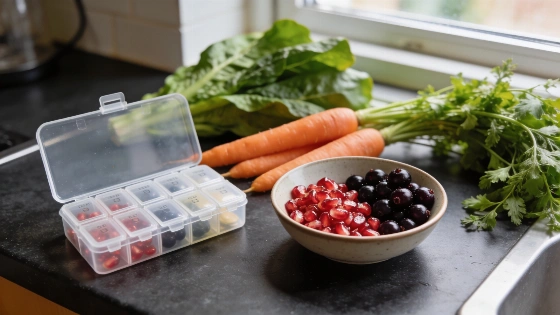
Most supplement makers have spent years chasing a single fix for healthy aging. One molecule, one pathway, one big promise. But new clinical trials on DailyColours, a supplement built around the full range of plant colors, point to a bigger problem. Most people just don't get enough of the many phytonutrients in fruits and vegetables. No single pill can match that mix.
DailyColours doesn't focus on one compound. It blends extracts from 16 Mediterranean fruits, vegetables, and herbs. The goal is to deliver over 160 phytonutrients, split into four color groups: red, blue-purple, green, and orange-yellow. The company holds patents on these blends and calls them new, but most of the data so far comes from lab tests, not large human studies.
DailyColours discloses a standardized blend of 16 Mediterranean plant extracts, but the Supplement Facts panel does not specify the exact milligram amount of each color group or individual phytonutrient, limiting transparency for consumers comparing active dosages.
So what do the clinical results show? The first human trial, run at King's College London, was a randomized, double-blind crossover study with 30 adults (average age 67). After a week on the supplement versus placebo, there was little change in inflammation, oxidative stress, or mitochondrial markers. A one-month extension in a smaller group found a shift at one DNA methylation site. But the authors said bigger and longer studies are needed to see if this matters in real life.
The second study, at the University of Exeter, was larger. It enrolled 150 adults aged 50 and up, all with a BMI of 25 or higher. Over 60 days, people took either 750 mg or 2,000 mg of DailyColours, or a placebo. The high-dose group got faster on a reaction-time task. Both supplement groups had small gains in picture-recognition accuracy. But there was no effect on memory or executive function. Physical test scores, like the Chair Stand Test, improved in all groups, including placebo. Systolic blood pressure went up more in the high-dose group, but the reason for this wasn't clear.
Proteomic analysis in a subset hinted at changes in immune and HDL-assembly pathways. These results are still early and need more study. The Exeter team called their work mechanistic and said it was too small to prove cognitive benefits. The supplement is built on the idea that it might copy some effects of the Mediterranean diet. But the evidence so far isn't strong enough to back up broad health claims.
Claims Check: While DailyColours markets its blend as supporting healthy aging and cognitive function, current FDA dietary supplement regulations prohibit disease treatment or prevention claims without substantial clinical evidence. The available human trials are exploratory and do not establish causality or clinical efficacy for cognitive or physical health outcomes.
Why focus on plant colors? The supplement industry often chases isolated compounds like NMN, spermidine, or fisetin. But aging is driven by a web of connected processes. Chronic inflammation, oxidative stress, immune decline, and gut changes all play a part. Targeting just one isn't enough. A 2023 review in Cell listed twelve linked hallmarks of aging, showing why a broader nutrition approach matters.
Public health advice, including from the USDA, keeps stressing the need to eat a wide range of fruits and vegetables. It's not just about vitamins and minerals. It's about the hundreds of phytonutrients that give plants their colors. Still, most adults fall short. UK survey data shows adults over 65 get just over 1,000 mg of polyphenols a day, mostly from tea and coffee, not from a mix of plant foods.
DailyColours says mixing all four color groups creates a stronger effect, but this is still a theory based on cell studies and patents. No human trial has directly compared the four-color blend to single-color extracts. The Mediterranean diet, full of colorful plant foods, is still the best real-world example. Observational studies link it to lower heart and dementia risk, but these are links, not proof.
For consumers, the main point is clear. No supplement can fully replace the range of nutrients in whole fruits and vegetables. DailyColours gives a concentrated, standardized option for people who can't meet intake goals, but its benefits still need to be proven in bigger, longer trials. Until stronger evidence comes in, the Mediterranean diet's focus on variety and color is still the gold standard for healthy aging nutrition.