
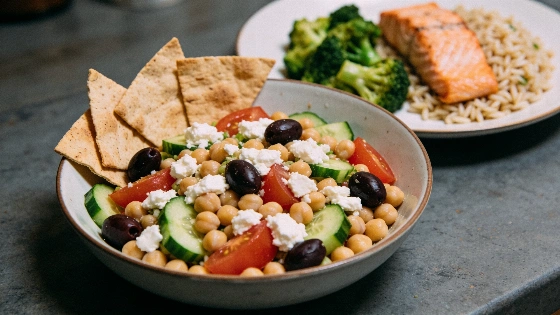
The recipe overview names Chickpea Chopped Salad with Pita Chips and Salmon with Lemon-Herb Orzo & Broccoli as two of its 29 quick dinners. Each recipe takes 30 minutes or less and provides at least 6 grams of fiber per serving. The overview describes the recipes as featuring ingredients that are prebiotic- and/or probiotic-rich.
The chickpea salad can work as a side or become a main with grilled or roasted chicken or salmon. It is built around familiar ingredients.
At least 6 grams of fiber per serving is about 21% of the FDA's 28-gram Daily Value used on Nutrition Facts labels. That figure describes the recipe serving; it is not a Supplement Facts dose or a personalized daily target.
Fresh ingredients and a practical shortcut
Chickpea Chopped Salad with Pita Chips pairs chickpeas with cucumber and tomato. Pita chips add crunch, while feta and olives bring a creamy, salty bite. A no-fuss dinner.
For Salmon with Lemon-Herb Orzo & Broccoli, add the broccoli to the pasta pot during the final minute of cooking. The meal comes together without an extra pot.
The 6-gram threshold makes it easier to compare servings, but it is only one part of a meal's nutritional profile. U.S. guidance commonly sets fiber needs at 14 grams per 1,000 calories. That works out to roughly 25 grams daily for women and 38 grams for men ages 19 to 50. The FDA uses a 28-gram Daily Value on Nutrition Facts labels. These figures serve different purposes, and individual needs vary. The FDA Daily Value explanation describes how to read the label benchmark.
That difference matters when a product page or package makes broad claims about "gut health." For powders and shakes, shoppers can check the Nutrition Facts or Supplement Facts panel for the amount and type of fiber, such as inulin, chicory root, psyllium or acacia. If a proprietary blend lists only a combined weight, it is harder to tell how much of each ingredient a serving contains. A blend name or a "clean" or "detox" claim does not prove a health outcome.
Gut microbes can ferment fiber from foods such as legumes, oats, vegetables and fruit. This process produces short-chain fatty acids. That helps explain why varied, fiber-containing diets matter in microbiome research. One dinner will not transform gut health. People increasing their fiber intake may find it easier to do so gradually and drink enough fluids, while adjusting for their own tolerance.
For weeknight meal planning, these recipes offer one practical option alongside make-ahead breakfast ideas. Choose dishes that fit the time available and use ingredients efficiently. These dinners provide a clear starting point: quick cooking and at least 6 grams of fiber per serving. A single meal is not a cure or a guaranteed gut-health intervention.