
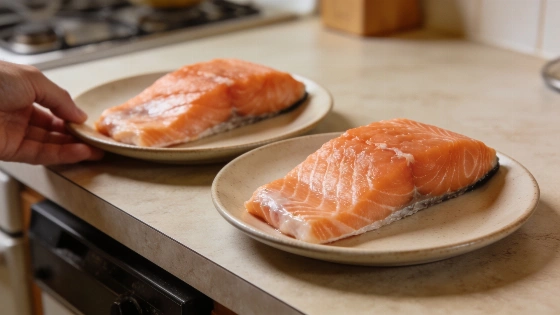
The American Heart Association recommends about two servings of fish a week. Many people eat fish less often than that. That gap matters.
Wild salmon is often leaner. Farmed Atlantic salmon typically has more total fat. But fat alone does not decide which is more nutritious. Species, preparation, and serving size all affect the comparison.
For a fair comparison, match the species, preparation, and serving weight. Farmed Atlantic salmon often has more total fat, but it does not necessarily provide less EPA and DHA per serving.
What the serving-size comparison shows
USDA figures for a three-ounce serving of Atlantic salmon list 155 calories, 21.6 grams of protein, and 7 grams of total fat for wild salmon. Farmed salmon has 175 calories, 18.8 grams of protein, and 11 grams of fat. Both have no carbohydrates in this comparison. The exact fish and whether it is raw or cooked can change the values. Treat these figures as a specific comparison, not a rule for every salmon product.
The USDA FoodData Central database lets shoppers check standardized food entries. Match the species and preparation details before comparing them.
The omega-3 figures complicate the claim that wild salmon is always nutritionally superior. In the same comparison, wild salmon provides 0.35 grams of EPA and 1.22 grams of DHA. Farmed salmon provides 0.59 grams of EPA and 1.24 grams of DHA per listed serving. Both also provide protein, selenium, and vitamin B12.
Claims Check: Salmon is considered a lower-mercury seafood choice, but that does not mean every fish is free of contaminants. FDA and EPA guidance identifies salmon among choices people can eat more often while still encouraging attention to seafood variety and applicable advice.
For another fish option, this canned sardine guide looks at omega-3s in a convenient choice.
What changes between wild and farmed
Wild salmon tends to be leaner. The feed used in aquaculture affects farmed salmon's fat profile. Some comparisons show differences in the balance of omega-3 and omega-6 fats. But the figures above do not make wild salmon the clear winner. Farmed salmon has slightly more EPA and DHA per listed serving. These nutrients can also vary by species, harvest, and preparation method.
Pink flesh does not, by itself, mean farmed salmon has been artificially dyed. Wild salmon get carotenoid pigments from their natural diet. Farmed salmon receive carotenoids through feed, a standard aquaculture practice.
Neither the wild nor farmed label guarantees a fish is free of contaminants. Potential exposure can vary by region, feed, and production controls. The label alone does not support a broad claim that one category is always "cleaner." Salmon is generally treated as a lower-mercury choice, but lower mercury does not mean zero contaminants. Labels have limits.
How to compare what you buy
At the shelf, compare the same species and state, raw or cooked. Check the portion weight and look for added oil, glaze, or seasoning. A packaged product's Nutrition Facts panel can show whether sodium or added ingredients change the practical comparison.
The serving basis matters with protein powders, too. Grams of protein per serving do not tell the whole story about calories, fat, or omega-3 content.
Sustainability labels answer a different question from nutrition numbers. The MSC ecolabel applies to eligible wild fisheries. The ASC label applies to aquaculture standards. These certifications can help with sourcing decisions, but they do not show that a product is nutritionally superior or free of contaminants.
For most diners, the practical choice is the salmon that fits their budget, preferences, and sourcing priorities. Eating fish regularly matters more than getting stuck on a rigid ranking. In the cited figures, wild salmon has more protein and less total fat. Farmed salmon delivers slightly more EPA and DHA. Both offer useful nutrients. Neither label tells the whole story.