
One sample of 1,239 Spanish olive oils showed how widely phenolic content can differ, with levels ranging from 1 to 2,850 mg/kg. A bottle's EVOO label does not show where its oil sits in that range.
Olive oil can fit into a nutritious eating pattern. Adding it to a meal is not a shortcut to better health. Check what the product contains, how much is in a serving and whether its marketing claims match the evidence.
Olive oil's main fat is monounsaturated fat. Extra-virgin olive oil, or EVOO, also contains phenolic compounds. Researchers study these compounds for possible antioxidant and anti-inflammatory effects. Their amounts vary widely between oils, and labels do not always list them.
Phenolic content can vary widely: one sample of 1,239 Spanish olive oils ranged from 1 to 2,850 mg/kg. The EVOO label alone does not tell you where a particular bottle falls in that range.
What its fats and plant compounds may do
Katie Conrad-McCoy, RDN, a registered dietitian at Kettering Health, says olive oil is rich in monounsaturated fat, mainly oleic acid. Roxana Ehsani, MS, RD, CSSD, LDN, points to phenolic compounds such as oleuropein, hydroxytyrosol, oleocanthal and oleacein.
Researchers study these compounds for possible effects on inflammation-related signaling. A proposed biological mechanism does not prove a health outcome.
That distinction matters. Olive oil is not proven to prevent or treat disease. A label claim such as "high polyphenol" is more useful when the product also gives a specific, supported amount. An ingredient or quality description alone is not a clinical result.
Conrad-McCoy describes oxidative stress as an imbalance between free radicals and the body's antioxidant defenses. Phenolic compounds in olive oil may contribute to antioxidant activity. Its monounsaturated fats can also replace some saturated fats in a diet.
Neither point means olive oil on its own prevents heart disease, cancer, diabetes or other conditions.
Claims Check: EFSA's authorised claim is narrow: 20 g of olive oil per day can help protect blood lipids from oxidative stress only when that amount supplies at least 5 mg of hydroxytyrosol and its derivatives. This is not a blanket endorsement of claims that olive oil lowers LDL cholesterol or blood pressure.
Clinical findings also caution against treating EVOO as a universal remedy. A review of 33 trials, as summarized in subsequent reporting, found lower insulin with EVOO. It found no significant effect on glucose, cholesterol, blood pressure or C-reactive protein.
Research has linked a Mediterranean diet rich in EVOO with lower cardiovascular risk. That finding concerns the overall diet, not a spoonful of oil acting as medicine.
Replacing some saturated fat with unsaturated fat may be one part of a varied diet. It does not prove olive oil alone improves the gut microbiome. Possible effects of phenols on oxidative processes also do not prove that olive oil protects the brain or prevents dementia.
How much to use and how to serve it
A tablespoon is a common serving. It still adds a meaningful amount of energy. USDA food-composition data put a tablespoon of olive oil at about 120 calories. The amount matters whether you drizzle it over vegetables or add it to a dressing.
The same attention to portions applies to other calorie-containing foods, including the avocado serving guide. Check the serving size on a shake's Nutrition Facts panel before comparing products or estimating how much you consume.
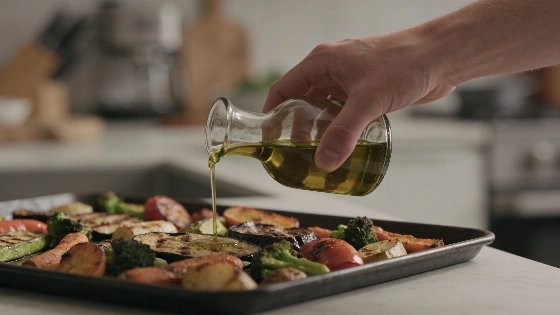
Olive oil works in dressings or drizzled over roasted vegetables, hummus or toast. You can also cook with it. Heating may reduce some phenolic compounds, but cooking with olive oil is not inherently unhealthy. Its suitability depends on the cooking method and temperature.
Make it part of the pattern
Ehsani recommends building meals around foods such as whole grains, fruits, vegetables, legumes and lean proteins. She also recommends using varied fat sources, including nuts, seeds, avocado and fatty fish.
Studies of Mediterranean-style eating support the broader dietary pattern. A randomized Mediterranean diet trial evaluated dietary patterns supplemented with EVOO or nuts. It did not test olive oil as a stand-alone treatment.
Use olive oil in portions that fit your needs. Treat broad health promises with the same care you would apply to a supplement blend. The type of fat, serving size and any quantified phenol claim tell you more than a promise on the front of the bottle. Olive oil can be a useful pantry staple, not a substitute for a balanced diet or medical care.
For a standardized calorie and nutrient reference, consult USDA FoodData Central. Product labels and serving sizes can vary. Use the serving listed on your bottle to work out your portion.