
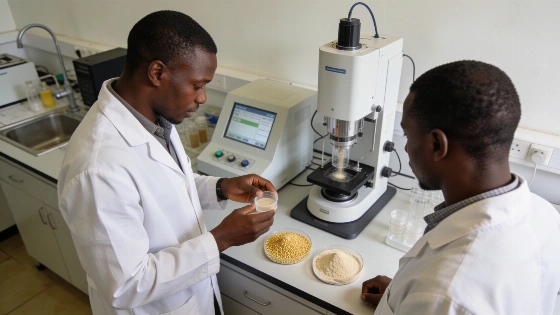
Researchers in Africa now have direct access to high-throughput labs for analyzing the nutritional and processing qualities of groundnut, sorghum, pearl millet, and finger millet. Set up by CIMMYT at Kiboko in Kenya and Thiès in Senegal, these new facilities are already changing how scientists, breeders, and students work on crop improvement and food product development.
Instead of sending samples overseas or relying on limited local testing, teams can now quickly measure key grain and flour traits-protein, oil, starch, color, and minerals like iron, zinc, and calcium-right where these crops are grown. This shift gives African research and breeding programs the data they need to develop better varieties and products for local diets and markets.
The new phenotyping labs enable rapid, on-site measurement of protein, oil, starch, and mineral content in dryland crops-key metrics that directly inform product formulation and label transparency.
For brands making nutrition shakes and meal replacements, this matters. Ingredient suppliers and formulators increasingly need accurate, batch-specific data for protein content, amino acid profiles, and micronutrient levels. With these labs, African-grown grains and legumes can be analyzed as thoroughly as more established protein sources, supporting clear Supplement Facts panels and more precise claims about protein, iron, zinc, and calcium content.
Having this local capacity also means less risk of outdated or generic nutrition values ending up on product labels. It supports the creation of regionally relevant blends-like millet- or sorghum-based protein powders-where protein-to-calorie ratios, mineral content, and allergen information can be checked against real lab data instead of assumptions or foreign benchmarks.
The labs are part of a broader effort under the Africa Dryland Crops Improvement Network (ADCIN). CIMMYT notes that this is an ongoing process, not a finished rollout, and just one step toward building lasting capacity for grain quality, nutrition, and processing research across African partner programs. The involvement of VACS fellows Odilon-Parfait Akotchaye and Meron Bogale, who will work across several sites, points to a growing pipeline for training and collaboration-important for scaling up both research and commercial use.
Claims Check: Nutrition and health claims on protein powders and meal replacements must be substantiated by accurate, batch-specific lab data. Under FDA regulations, brands are required to use validated analytical methods for nutrient content and cannot make disease treatment claims. The new labs in Africa support this standard by enabling local verification of protein, mineral, and micronutrient levels in dryland crop ingredients.
For shoppers, this could mean future products featuring African-grown millet, sorghum, or groundnut will have more accurate and transparent Supplement Facts panels-possibly with third-party certifications or independent lab verification. This is especially relevant for people looking for plant-based protein powders or superfood blends that claim specific protein percentages, iron or zinc content, or allergen-free status. As the labs expand and methods are validated, ingredient quality and label accuracy are expected to improve, narrowing the gap between marketing claims and actual nutrition.
The real test for these phenotyping labs will be their impact on both research and the marketplace. If the data leads to better crop varieties and more reliable product labels, the investment will benefit African farmers, food companies, and consumers worldwide. For the nutrition shake sector, this is a move toward greater ingredient transparency and evidence-based product development-important for anyone checking a Supplement Facts panel or comparing protein sources on the shelf.