
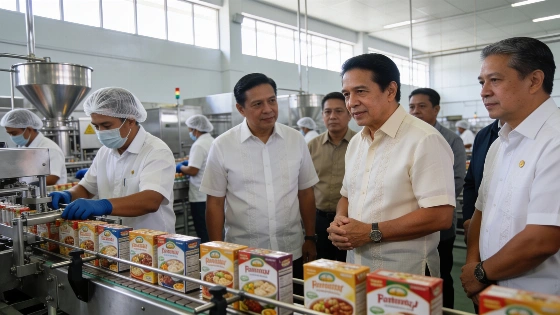
President Ferdinand "Bongbong" Marcos Jr. visited Nutridense Food Manufacturing Corporation in Sta. Barbara, Pangasinan, signaling that expanding nutritious food production for small businesses is now a government priority. Joined by Department of Science and Technology Secretary Renato U. Solidum Jr., Marcos highlighted how government-backed research can move food innovation from the lab into real manufacturing.
Marcos addressed the main challenge directly: "Now, one of the biggest problems we face is, we have a lot of great scientists, a lot of researchers, but from the laboratory to manufacturing, the scaling up of the production, that is what needs to be studied," he told local reporters. Nutridense, a micro, small, and medium enterprise (MSME), is testing this transition with support from the DOST's Small Enterprises Technology Upgrading Program and the Food and Nutrition Research Institute.
Nutridense utilizes over 40 DOST-developed food technologies, including iron-fortified rice, high-protein crackers, and ready-to-eat meals, with label transparency on macronutrient content and fortification levels critical for government feeding programs.
During the visit, Marcos confirmed that the government is helping Nutridense acquire more machinery to increase output. The goal is not just to produce more food, but to make products with real nutritional value-something that matters for Filipino families and national food security.
While in Pangasinan, Marcos also visited the Department of Education's School-Based Feeding Program at Sta. Barbara Central School. The program currently serves 50 severely undernourished students, providing meals designed to address urgent nutritional needs. At the same event, the Yaman ng Kalusugan at Kalinga Caravan offered free medical consultations, dental checkups, and medicines to about 200 learners, parents, and teachers.
For many children, school feeding programs are the only steady source of balanced nutrition. The government's direct involvement aims to make these efforts more effective and reach more families.
Claims Check: While products like iron-fortified rice and high-protein crackers are marketed for their nutritional benefits, FDA regulations require that any health or structure/function claims be substantiated by clinical evidence and clearly disclosed ingredient dosages. Brands must avoid implying disease treatment or prevention unless supported by rigorous trials and regulatory approval.
The Nutridense example shows how targeted government support can help small businesses turn scientific research into real food products. By investing in equipment and technical skills, the administration wants to make sure nutritious food is not just a concept but something families can actually buy-especially those most at risk.
Marcos's visit marks a shift toward practical support for businesses and programs that can deliver measurable results. The real question is whether these efforts will lead to lasting improvements in child nutrition and a stronger food manufacturing sector. For now, the government's backing of both innovation and direct feeding programs is a concrete step for families who need more than promises-they need real, nutritious food on the table.
For consumers, the Nutridense case is a reminder to check Supplement Facts panels, look for clear fortification details, and seek out evidence-based claims. As more products like iron-fortified rice and protein-enriched snacks appear, shoppers should look for third-party certifications such as NSF Certified or NIH ingredient fact sheets to confirm label accuracy and safety.