
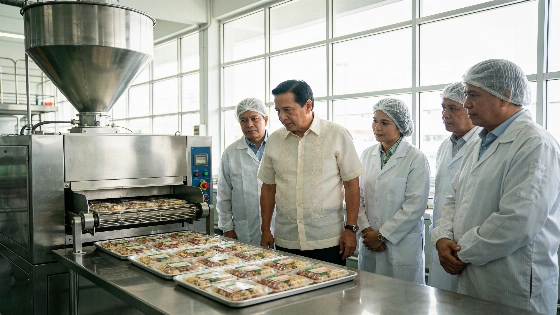
President Ferdinand Marcos Jr. wants to see nutrition research put to practical use, not left on the shelf. After visiting Nutridense Food Manufacturing Corp. in Sta. Barbara, Pangasinan, he called for a nationwide effort to turn food technology breakthroughs into products that reach Filipino households.
The Department of Science and Technology's Food and Nutrition Research Institute (DOST-FNRI) has developed several food technologies, now being commercialized with help from the agency's Small Enterprises Technology Upgrading Program (SETUP). Nutridense, for example, has expanded its operations using government-supported equipment like kernel extruders and blending machines worth over PhP3 million.
"Nutridense has implemented around 40 DOST-developed technologies, with products like iron-fortified rice, high-protein crackers, and enhanced Nutribun now distributed in 16 regions across the Philippines."
Shake Nutrition Editorial Desk
Marcos stressed that the challenge is not inventing new foods, but making sure they are produced and distributed widely. "Hindi lang isang factory, hindi lang isang laboratory, kung hindi isang buong sistema ang ating binubuo para patuloy ang maganda ang magiging production at sa ganung paraan ay natutulungan nga natin ang ating mga kabataan na kumain ng tama at masustansya na pagkain," he said. His goal is a system that goes beyond one-off projects, so nutrient-enriched foods are made at scale and delivered where they are needed most.
Nutridense currently supplies fortified foods to the Department of Social Welfare and Development (DSWD) and to schools, focusing on children's nutrition. At Sta. Barbara Central School, 50 severely undernourished students recently received hot meals and nutrition packs from Nutridense, with plans to reach 385 children in the next school year. This direct link from manufacturer to feeding programs shows how public and private partnerships can help turn research into practical, nutritious products.
Claims Check: While terms like "fortified" and "high-protein" are regulated, brands must back up these claims with clear Supplement Facts panels and ingredient lists. The U.S. FDA requires that claims such as "high in iron" or "good source of protein" meet specific amounts per serving, and all added micronutrients must be listed on the Nutrition Facts label.
FDA / Clinical Nutrition Review
For Filipino families, food security and nutrition are ongoing concerns, especially for children and vulnerable groups. By focusing on mass production of nutrient-enriched foods, the government hopes to make balanced, fortified meals more available and affordable. This could help address common gaps in protein, vitamins, and minerals in many diets. For shoppers, clear labeling matters: knowing the protein-to-calorie ratio, serving size, and whether foods contain allergens or added sugars is important, especially as more functional foods and meal replacements appear in stores.
Marcos made it clear that this effort is not just for Pangasinan. The plan is to expand these programs nationwide, building a system that delivers real nutritional improvements for families, not just small pilot projects. His call for a "buong sistema"-a whole system-signals a move toward coordinated, technology-based nutrition solutions, in line with global best practices for food fortification and public health.
With the president's direct involvement and a push for collaboration, the Philippines is moving from scattered nutrition programs to a more unified, technology-driven approach. The real question is whether these partnerships can deliver healthier meals for millions of Filipinos. As these fortified foods reach more households, label transparency, ingredient disclosure, and regulatory compliance will remain important for both consumers and nutrition professionals. For more on nutrient content claims and labeling standards, see the FDA's nutrient content claim guidelines and the USDA FoodData Central for nutrition benchmarks.