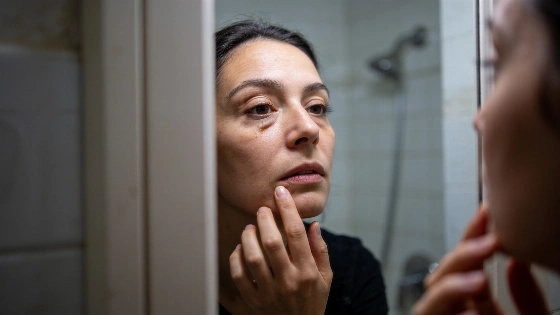
A registered dietitian brought years of iron deficiency under control and noticed the shadows beneath their eyes grow lighter. The change was real, but it did not prove that low iron caused the circles. Research points to a possible connection, not a settled explanation.
Dark circles have many potential causes. Their appearance alone cannot establish iron deficiency.
Studies of periorbital hyperpigmentation, the clinical term for dark circles, have reported iron-deficiency anemia among people with the condition. In one study, half of the participants with dark circles also had iron-deficiency anemia. Many said the darkness under their eyes improved after treatment.
Another clinical study found iron-deficiency anemia in 41% of people with dark circles. A smaller observational study also suggested a link.
Those findings do not show that low iron causes dark circles. The studies were observational and involved relatively small groups, so they cannot establish cause and effect or show that the results apply to everyone. Larger studies are needed to confirm the pattern.
It is still worth discussing the possibility with a clinician. Iron deficiency can affect health beyond appearance, and a blood test can help assess it. Low iron can develop before anemia: ferritin, a measure of the body's iron stores, may be low even when hemoglobin is normal.
A complete blood count and ferritin test can help assess iron status. Without inflammation, ferritin below 30 micrograms per liter, the same numerical value as nanograms per milliliter, may indicate deficiency in adults and in children older than five. For children under five, clinical guidance cites a threshold below 12 micrograms per liter. These are guideposts, not stand-alone diagnoses. Inflammation can raise ferritin. So can infection or some chronic conditions, potentially masking depleted iron stores. In those circumstances, clinicians may also consider transferrin saturation. The clinical recommendations summarized by Apteka online emphasize interpreting iron tests in context.
For adults, guidance discussed by the American Society of Hematology uses a ferritin level around 30 ng/mL as a threshold when there is no known inflammation. For people with symptoms or ongoing risk factors, clinicians may consider a threshold as high as 50 ng/mL. In patients with anemia and inflammation, ferritin should not be read on its own: deficiency may be considered when ferritin is below 100 ng/mL or transferrin saturation is below 20%. A discussion of the ASH thresholds explains why results need to be considered alongside symptoms and clinical history.
Why iron might affect the area beneath the eyes remains unclear. Iron helps the body make hemoglobin, the protein in red blood cells that carries oxygen. Researchers have proposed that low iron could reduce oxygen delivery to tissue around the eyes, but that explanation has not been clearly established. Skin beneath the eyes is thin, which can make nearby blood vessels easier to see.
Iron-deficiency anemia can also cause pallor. When the surrounding skin looks paler, shadows or visible vessels beneath the eyes may stand out more by contrast.
Fatigue could be another indirect factor. Low iron is associated with tiredness, and poor or insufficient sleep can make dark circles more noticeable.
None of these possibilities makes dark circles a reliable sign of low iron. A clinical explanation of low ferritin with normal hemoglobin notes that iron stores can be depleted before anemia appears.
Genetics can affect pigment around the eyes. Allergies may cause congestion and swelling. Rubbing itchy eyes can darken the skin over time.
Aging can reduce collagen and fat beneath the eyes, creating hollows and shadows. Naturally thin skin can also make underlying blood vessels easier to see. Sleep may contribute, but it is rarely the whole explanation.
Consider a medical check if dark circles come with persistent fatigue or shortness of breath during everyday activity. Pale skin can also be a symptom. So can cold hands and feet, brittle nails, headaches or dizziness.
Heavy periods and pregnancy can increase the likelihood of low iron. Frequent blood donation is another risk factor. Eating little or no meat can raise the likelihood, as can digestive conditions that affect absorption.
A clinician can assess iron status with bloodwork. A complete blood count and ferritin test provide more information than symptoms alone. Depending on the results and clinical context, testing may also include transferrin saturation or markers of inflammation.
Do not start iron supplements without medical guidance. Too much iron can cause side effects and build up to harmful levels.
Lean red meat and poultry are food sources of iron. Fish is another. Plant sources include beans, lentils and tofu; fortified cereals also provide iron.
Iron from animal foods is absorbed more easily. Pairing plant sources with vitamin C-rich foods, such as bell peppers or citrus, can help absorption. Strawberries and tomatoes are also vitamin C-rich options.
Rebuilding iron stores may take months. Addressing iron would not rule out other causes of dark circles. Allergy management may help their appearance. Sun protection and adequate sleep may help too.