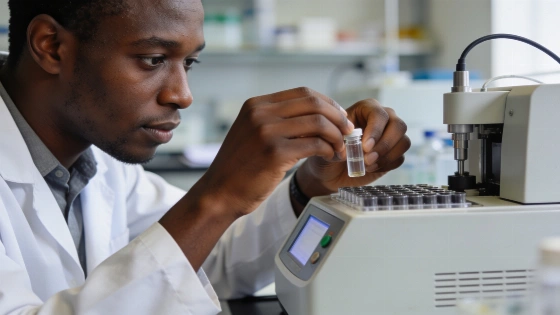
Eighteen African nutrition specialists have completed stable-isotope research training, adding a new technical resource for a continent facing childhood stunting and rising diet-related non-communicable diseases.
The two-year master's programme trains graduates to produce measurements that can inform nutrition research and public health decisions. Its methods can assess body composition and energy expenditure. They can also measure nutrient bioavailability and breast milk intake in infants, with minimal invasiveness.
The first graduates are already putting those methods to work.
Senegal's Nibourou Top studied vitamin A intake among breastfed infants in Dakar. She is interning with the IAEA's Nutritional and Health-Related Environmental Studies Section. Top plans to pursue a PhD on the bioavailability of provitamin A from plant-based foods.
Other projects focus on iron deficiency and body-composition measurement. Zimbabwe's Pauline Tsikayi used stable iron isotopes to investigate iron absorption, addressing high rates of anaemia and iron deficiency among young African women. Rwanda's Phionah Nziza compared the deuterium dilution technique with bioelectrical impedance analysis to improve body-composition measurement in African populations.
Students study epidemiology and statistics. Nutrition policy is also part of the curriculum. They complete a field assignment and a thesis using data generated through stable-isotope methods. Health professionals from 22 African countries developed and validated the curriculum in line with the African Union's Agenda 2063.
The programme is delivered through the University of Ghana and the International University of Rabat. North-West University and Mukuba University in Zambia also deliver it. Another programme is under development at Université Cheikh Anta Diop in Senegal.
The regional effort has been years in the making. The IAEA and African Union Commission signed their first practical arrangements supporting peaceful uses of nuclear technology in Africa in 2018. The need for a harmonised nutrition curriculum came up at the 10th Africa Day for Food and Nutrition Security in Cairo in 2019.
University experts drafted a framework in Vienna in 2022. A regional meeting validated it in Lusaka in 2023. The programme launched at the Federation of African Nutrition Societies Conference in Dakar that November.
Gashaw Wolde, Acting Director of the IAEA Division for Africa, said human resource development remains a priority. Graduates are returning home with skills to help shape nutrition strategies for national needs. May Abdel-Wahab, Director of the IAEA Division of Human Health, described the programme as a long-term investment in research. She said it would support evidence-based policy and a new generation of African nutrition specialists.