
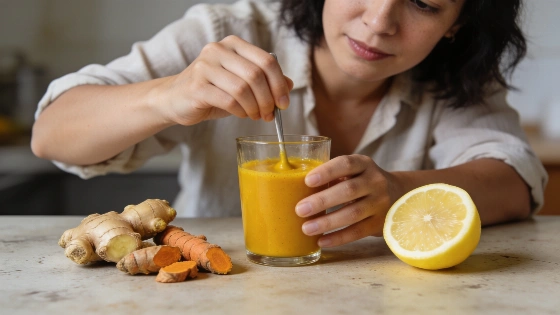
Each morning, registered dietitian Marissa Perrotta dilutes fire cider with water. Her recipe centers on turmeric and ginger, which she chose after researching their potential health benefits. That is no proof of stronger immunity.
A product name or ingredient list alone does not reveal how much turmeric or ginger a serving contains. Check the Nutrition Facts or Supplement Facts panel for serving size, calories, added sugars, and any disclosed ingredient amounts; a proprietary blend may list a total weight without showing each ingredient's dose.
What turmeric and ginger bring to the shot
Turmeric contains curcuminoids, including curcumin. Researchers have studied these compounds for biological effects such as anti-inflammatory activity. The FDA's "no questions" response to a specific GRAS notice covers the intended use described in that notice. It does not find that turmeric shots prevent illness or provide an immune benefit. The notice also says some uses may require a color additive listing. The FDA GRAS notice spells out its scope.
Ginger has a long history in cooking and has been studied for digestive effects. That does not establish it as an immune therapy. Federal regulations list ginger-related substances for use in food under specified conditions. Food-ingredient status is not evidence that a concentrated shot prevents or treats disease. The food ingredient regulation does not endorse an immune claim.
Studies of possible effects in particular settings do not prove that a daily shot prevents infections or measurably strengthens immunity. Culinary use, an extract, and a concentrated drink can differ in form and amount. Findings about one preparation do not automatically apply to another. The evidence has limits.
A routine built around convenience
Perrotta took up the habit because a shot offered an easy, affordable way to use turmeric and ginger regularly. For a look at other ingredient-based wellness claims, see Shake Nutrition's evidence review of green tea.
For a bottled shot, check the serving size and calories. Look for added sugars and read the full ingredient list. If a brand lists a turmeric or ginger blend but not the amounts of each ingredient, shoppers cannot compare those doses across products. Price per serving can help compare convenience. It does not show that one product works better.
The concentrated taste may not suit everyone. Perrotta's alternative is to add turmeric and ginger to familiar foods such as smoothies, soups, yogurt, or oatmeal. Using the spices this way can be practical. It does not mean treating them as a supplement or a substitute for medical care.
Her routine leaves room for choice. Turmeric and ginger can fit into a daily eating pattern without a shot. Treat the drink as a convenient food habit, not a proven immune shield.