
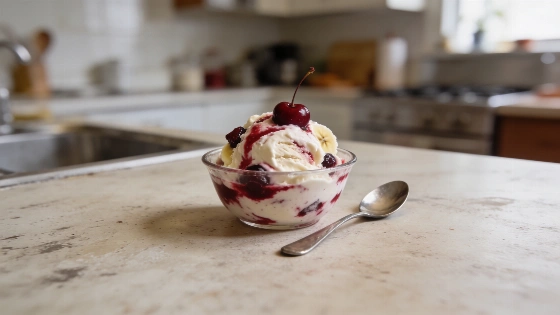
The four-ingredient recipe takes about 10 minutes to make. Ripe bananas form the creamy base; tart cherry juice adds a sour edge. One serving has 5 grams of fiber and no added sugar. That's the nutrition story.
What goes into the dessert
Bananas bring natural sweetness, so the recipe needs no added sugar. It may suit someone looking for a quick fruit-based dessert.
The recipe provides 5 grams of fiber per serving and no added sugar. 'No added sugar' does not mean sugar-free: fruit and juice can still contribute naturally occurring sugars.
The distinction matters on food labels, too. Check the serving size, total sugars, and added sugars. A "no added sugar" description does not mean a food contains no sugar.
A recent review of tart cherry supplementation found no statistically significant overall improvement in sleep quality. The effect size was Hedges' g=0.064, with a 95% CI of -0.147 to 0.275 and P=0.552. In a subgroup of participants with insomnia, the review found a significant improvement: Hedges' g=0.732, with a 95% CI of 0.051 to 1.412 and P=0.035. These results concern supplements. They do not show that a serving of cherry juice dessert has the same effect.
The review found no significant effects on melatonin or inflammatory biomarkers. The proposed sleep-related mechanisms remain uncertain. Bananas contain potassium and vitamin B6, but the evidence is indirect. It does not establish that eating a banana dessert improves sleep. Fiber is part of a balanced diet, not a guaranteed sleep benefit. For the difference between total and added sugars on a nutrition label, see the FDA Nutrition Facts guidance.
Claims Check: A meta-analysis found no significant overall sleep-quality benefit from tart cherry supplementation, although a subgroup of participants with insomnia improved. The review did not find significant changes in melatonin or inflammatory biomarkers; results from supplement studies should not be presented as proof that this dessert treats sleep problems.
A single bedtime snack is only one part of a person's eating pattern. Our coverage of ultra-processed foods examined broader health associations. A recipe is not a stand-alone health fix.
Tart Cherry Nice Cream works as a quick fruit-based dessert with fiber and no added sugar. It is not a guaranteed route to better sleep. Enjoy it for what it is. The available evidence does not establish that this dessert improves sleep.