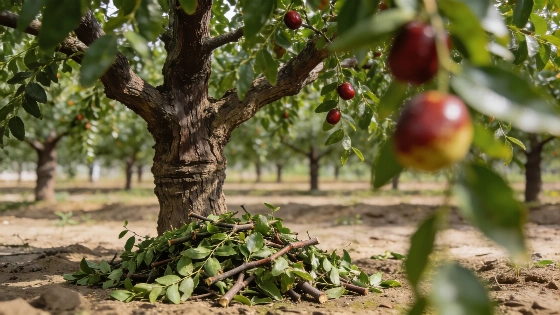
Researchers sampled six-year-old Jinsixiaozao and Dongzao trees, then compared the minerals in their tissues with levels in the surrounding soil.
The team at Hebei Agricultural University measured 32 mineral elements in fruit and leaves. Winter-pruned branches were also analyzed. The researchers tested the same elements in nearby soil.
The study, "The uptake features of mineral elements in jujube trees and the relationship with soil supply," was conducted by Kun Feng and Jiaqing Cai. Mengjun Liu was also an author. The researchers note that mineral-nutrition theory has drawn heavily on annual herbaceous crops, while perennial fruit trees have received less systematic study. The paper is listed by Springer Nature.
Soil mineral levels did not significantly correlate with the amounts found in the trees. Soil mineral content and the amount available for uptake are different measures. The results may also reflect how a tree takes up elements and distributes them among its tissues. The study covered two jujube cultivars, so its findings apply to this crop and these cultivars, not to fruit trees in general.
A soil test alone did not tell the whole story.
Phosphorus uptake was notably low. That finding puts limits on fertilizer assumptions drawn mainly from annual herbaceous crops. The study does not establish a universal phosphorus requirement for jujube, and it gives no fertilizer rate for growers to use.
Leaves held the most total mineral content. Branches held less, while fruit contained the least. Macroelement content differed substantially between the cultivars. Their microelement content varied less, as did their non-essential element content. Mineral contents across the tree's tissues were correlated, most strongly between leaves and branches.
Pruned branches and fallen leaves contain substantial minerals. The authors suggest returning this material to the field to recycle nutrients instead of removing it as pruning waste. They did not calculate how much fertilizer that practice could replace.
The study offers an element-by-element assessment for both cultivars. It supports considering soil results alongside measurements of plant tissue. Crop yield also belongs in that assessment, as do cultivar characteristics. The authors say the findings provide a basis for further work on fertilizer management and nutrient recycling in perennial orchards.