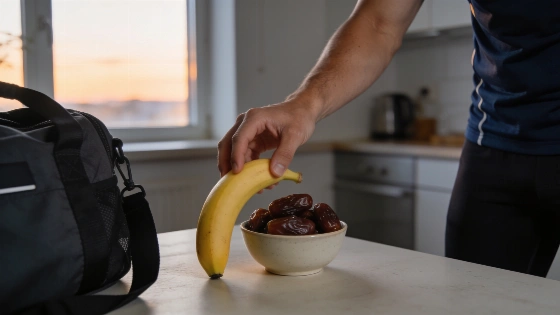
At dawn, appetite can lag behind the alarm. A full breakfast is not required before every workout. For people who wake without much appetite, a banana or a few dates offers portable carbohydrates without the work of preparing a meal.
The decision comes down to how much fuel the session calls for and what feels comfortable before exercise. Matthew Landry, PhD, RDN, FAND, FAHA, at the University of California Irvine, recommends these foods for early sessions. Keep the snack light enough to manage, then match the portion and timing to the workout.
Date portions are not interchangeable: one Medjool date has about 18 g of carbohydrates, compared with about 5.3 g in one Deglet Noor. Naming the variety and portion makes the snack's carbohydrate estimate more useful.
Why bananas and dates fit an early workout
A medium banana contains about 105 calories and 27 grams of carbohydrates. Roughly 14 grams are naturally occurring sugar. It has less than a gram of fat and about one gram of protein, making it a relatively light choice for someone who struggles with heavier foods before exercise. USDA FoodData Central provides standardized fruit entries for comparison, though size and serving assumptions still matter.
That simplicity is the appeal. A banana needs no preparation, and dates are shelf-stable and portable. But "dates" alone tells you little about the carbohydrate dose. Five Deglet Noor dates provide roughly 235 mg of potassium. Five Medjool dates provide about 835 mg. People with kidney disease or a prescribed potassium restriction should account for that difference with their care team.
Claims Check: A phrase such as 'clean energy' on a powdered drink does not, by itself, show that the product improves a workout. FDA rules distinguish structure/function claims from disease claims; shoppers should assess the claim separately from the disclosed ingredients and amounts.
Match snack timing to your schedule
A small, easy-to-digest carbohydrate snack may work shortly before exercise. A fuller meal with carbohydrates and some protein is generally better planned a few hours ahead, often around two to four hours, depending on the session and individual tolerance. With only 15 to 20 minutes to spare, a modest portion may feel more comfortable. Hydration matters, especially during longer or harder workouts.
For a brief, light early workout, a banana or a few dates may be enough for someone who feels good exercising after a small snack. Longer or more intense training can call for a broader fueling plan. Sports guidance commonly uses roughly 30-60 grams of carbohydrate per hour for prolonged exercise. That figure is not a target for every workout, or a prescription for one early-morning bite.
A shake is not automatically a better choice because its label lists protein or added vitamins. Start with the serving size in grams. Check the calories, then the carbohydrate and protein amounts per serving. Note the added sugars too. For powders, compare the actual scoop weight and cost per serving rather than judging tubs by price alone.
Sweeteners and added fibers such as inulin or chicory root may not suit every stomach close to exercise. A proprietary blend can also obscure how much of each ingredient a serving contains. "A Better Snack Starts With One Practical Question" offers a broader way to weigh what makes a snack useful in different situations.
There is no need to force down a full meal when appetite is low. For a longer or tougher session, plan more deliberately. FDA rules distinguish structure/function claims from disease claims, and the agency says shoppers should assess claims separately from disclosed ingredients and amounts.