
In a reported mouse experiment, stool from women with PMOS worsened ovarian function and insulin resistance in the animals. That result comes from mice; it does not show that the same effect occurs in people.
The available search evidence does not verify that the study appeared in Nature Medicine or confirm later human clinical trials. The reported links between Bacteroides vulgatus, certain bile acids, and interleukin-22 also need to be read as preclinical findings. Bile acids help with digestion and act as signaling molecules, but animal results do not establish that a treatment or supplement works in people.
A Supplement Facts panel can show how many grams of fiber or protein a serving contains; it cannot, by itself, establish that a product changes hormone levels or improves microbiome diversity.
How microbes may affect hormone signals
The gut does more than process food. Enterochromaffin cells produce much of the body's serotonin, and gut microbes can affect that production. Serotonin helps regulate gut movement. Fermentation products from fiber can also prompt cells in the colon to release GLP-1 and PYY, hormones involved in blood sugar regulation and fullness.
Much of the detailed evidence for these processes comes from cell and animal studies. Experiments link short-chain fatty acids, including propionate, with FFAR3 signaling and increased GLP-1 and PYY secretion. That does not prove that a particular shake or fiber powder will cause a meaningful hormonal change in a person. Research indexed in PubMed discusses these mechanisms.
Estrogen metabolism may offer another connection. The estrobolome is the collection of bacterial genes and enzymes involved in estrogen metabolism. Bacterial beta-glucuronidase may affect how estrogen metabolites are deconjugated in the gut. Researchers are still investigating how this works in people and what it means for health.
The same food may affect people differently. Gut bacteria can turn the soy isoflavone daidzein into S-equol, a compound with estrogen-like activity and relatively strong affinity for estrogen receptor beta. Whether someone produces equol depends on their microbiome. One review estimates that around 25-30% of Western women and 50-60% of Asian women produce it. Estimates vary by population and measurement method, so they are not universal rates.
For shoppers, the distinction is between an ingredient and the body's response to it. A shake with soy protein or an isoflavone-rich blend does not guarantee equol production. And unless a product lists the relevant ingredient and amount, a broad phrase such as "hormone balance" says little about what the formula is meant to provide.
Why diversity matters more than a strain count
A probiotic count on a label cannot tell you the full story about likely benefits. Probiotics may help in specific circumstances, but results depend on the strain, dose, person, and outcome studied. Evidence for one probiotic does not automatically apply to every multi-strain capsule or probiotic powder. The NIH Office of Dietary Supplements explains that probiotic evidence depends on the strain and condition.
The word "prebiotic" on a tub also does not tell you how much fermentable fiber it contains. Check the Nutrition Facts panel for fiber per serving and the ingredient list for sources such as inulin, chicory root, psyllium, or acacia. Fibers differ in their properties and how well people tolerate them; fermentable fibers can cause gas or bloating for some. A proprietary blend that lists only a combined weight makes it harder to see the amount of each ingredient.
Food can provide a wider range of microbial fuel than one isolated ingredient. In the observational American Gut Project, people who reported eating more than 30 types of plant foods a week had more diverse microbiomes than those who reported 10 or fewer. The comparison does not prove that eating a particular number of plants causes a health benefit, but it supports variety as a practical dietary pattern. A varied breakfast can contribute too; these meal-prep ideas offer examples.
Fermented foods also have early evidence from human trials. In a study of 36 healthy adults, a diet high in fermented foods increased microbial diversity and reduced levels of several inflammatory proteins. The high-fiber group did not show a change in diversity over the same period. The small trial offers useful evidence, but it does not show that fermented foods or supplements treat inflammation. Foods discussed in this context include curd, kefir, kanji, fermented idli and dosa batter, tempeh, and traditionally fermented vegetables.
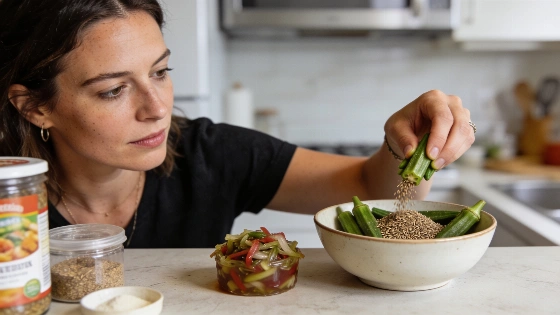
The type of fiber matters, not just the total amount. Okra, cluster beans, and flax gel contain mucilage. Gut microbes can use fermentable fibers and resistant starch to produce short-chain fatty acids. For a powder, compare the fiber grams per serving, serving size, and fiber source instead of relying on a "microbiome" or "cleanse" claim. A large or sudden increase in fiber may not suit everyone.
Keep claims in proportion
The microbiome includes fungi, viruses, archaea, and protozoa as well as bacteria. Research has linked changes in fungal composition with inflammatory bowel disease, but the hormone-related implications remain early. Methane-producing archaea have been linked with slower gut transit and constipation-predominant IBS. Researchers are still exploring a proposed link between transit time and the reabsorption of compounds excreted in bile, including estrogen.
Gut function can affect the absorption of iodine, selenium, iron, and zinc, which are relevant to thyroid hormone production. Studies of autoimmune thyroid disease have reported differences in bacterial groups such as Bifidobacterium and Lactobacillus. The findings are not consistent enough to diagnose a gut problem from symptoms such as fatigue, hair shedding, or low ferritin.
Recent research has also found an association between more pronounced premenstrual symptoms and lower levels of some bacterial groups, particularly Bifidobacterium. That association does not show that microbes caused the symptoms, or that changing someone's microbiome will relieve them.
For a product, check the ingredient list and Supplement Facts panel for clear amounts. Compare fiber per serving, added sugars, serving size, and allergens, and be cautious with proprietary blends that hide individual doses. A varied diet can supply different microbial substrates, but hormone-related microbiome findings remain promising and incomplete. They do not support a universal prescription for a powder, shake, or supplement.