
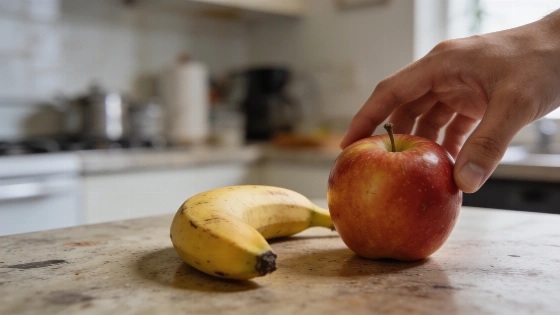
A medium apple has about 95 calories and 4 grams of fiber. A medium banana has about 105 calories and 3 grams of fiber. Both can fit into a balanced eating pattern, and neither needs to be avoided because of its natural sugar.
A medium apple has about 95 calories and 4 grams of fiber; a medium banana has about 105 calories and 3 grams of fiber. The numbers describe different strengths, not a weight-loss winner.
What the nutrition numbers favor
A medium apple has about 95 calories, 4 grams of fiber and roughly 86% water. A medium banana has about 105 calories and 3 grams of fiber, plus 422 milligrams of potassium and 32 milligrams of magnesium. Apples edge ahead on fiber. Bananas have more potassium.
It is a small difference. It is not a reason to treat one fruit as a weight-loss tool and the other as a problem. Fiber matters across your whole day. U.S. guidance recommends 14 grams per 1,000 calories. That typically means 25 grams daily for women ages 19 to 50 and 38 grams for men in that age range, as summarized by the NIH fiber guidance.
Claims Check: A fruit's fiber and calorie numbers can help explain how it may fit into a meal, but they do not establish that the fruit causes weight loss. Weight-management guidance emphasizes an overall reduced-calorie eating pattern rather than a single supposedly slimming food.
Whole fruit beats the shortcut
Eat apples whole, with the peel, for more fiber. A peeled apple has about 2 grams of fiber; one with the skin has around 4 grams. For a 2,000-calorie eating pattern, USDA MyPlate suggests about 2 cups of fruit daily and favors whole fruit over juice for its fiber. The MyPlate fruit guidance also gives serving examples. Individual needs can vary.
Applesauce and 100% apple juice can count toward fruit intake. But they generally have less fiber and volume than a whole apple. Juice is also quicker to drink, so some people may find it less satisfying.
A banana's carbohydrate profile changes as it ripens. Green bananas have more resistant starch. As they ripen, some of that starch becomes simpler carbohydrates. Resistant starch can act as a prebiotic fiber. Ripe bananas still fit a balanced diet.
Bananas contain roughly 14 grams of natural sugar. That is not the same as the added sugar in sweets and many packaged foods. Bananas also contain fiber, water and other nutrients. Prefer a smaller portion? Choose a small banana. There is no need to avoid the fruit altogether. For a separate look at natural sweeteners, see this sweetener comparison.
Choose by the job the snack needs to do
A banana's easy-to-use carbohydrates can make it a handy snack before exercise. An apple may suit someone looking for a snack with more fiber. Either fruit can be more satisfying with a tablespoon or two of peanut butter, if that suits your preferences and dietary needs.
A fruit-flavored protein shake or powder is not the same as whole fruit. Flavor alone does not tell you whether it has the same fiber or volume. Check the Nutrition Facts panel for serving size, calories, fiber and added sugars. For powders, check protein per serving and the ingredient list too. Claims such as "gut health" or "clean energy" do not replace disclosed amounts or relevant evidence.
You do not need to force down the fruit you like less. Keep apples or bananas where they are easy to see. Pair them with foods you enjoy. Treat them as options, not rivals.
The verdict is simple: apples have a slight edge in fiber, while bananas bring more potassium and convenient workout fuel. Neither has a special claim to weight loss. Choose the fruit you will actually eat. Calories or natural sugar alone do not make one a winner.