
Current heart-health guidance favors whole grains and other fiber-rich foods. It also recommends replacing saturated fats with unsaturated fats and limiting refined carbohydrates.
At the store, check serving size, fiber and added sugars on the Nutrition Facts panel. The serving listed on the box may be smaller than the portion in your bowl. Compare the amounts you actually eat. The FDA explains how to read added sugars on labels. That number helps, but it tells only part of the story.
Among these five examples, Kashi Go Protein + Fiber lists 12 grams each of fiber and protein per 1¼-cup serving, while Raisin Bran lists 9 grams of added sugar per cup. Serving sizes differ, so compare each panel at the portion you actually eat.
Higher fiber and lower added sugar stand out
Catalina Crunch Chocolate Peanut Butter Protein Cereal has the most protein of the five. A ¾-cup serving has 17 grams of protein, 9 grams of fiber and no sugar or added sugar. It also has 220 calories and 270 milligrams of sodium. Dietitian Deborah Murphy, M.S., RDN, says protein and fiber can make breakfast more filling. That may help when comparing cereals. It does not show that this product lowers triglycerides.
Food for Life Ezekiel 4:9 Golden Flax Sprouted Crunchy Cereal combines whole grains, lentils, beans and flaxseed. Its ½-cup serving has 7 grams of fiber, 8 grams of protein and 1 gram each of total and added sugar. Sheri Gaw, RDN, points to its ingredients and fiber. A 2022 systematic review and meta-analysis reported improvements in blood lipids, including triglycerides, with flaxseed among people with dyslipidemia. The review did not show that this cereal has the same effect.
Claims Check: A cereal's fiber content or whole-grain ingredients can support a heart-conscious eating pattern, but neither makes the food a treatment for high triglycerides. NIH consumer guidance discusses triglycerides in the context of overall health and care, not as a condition that can be managed by choosing one breakfast product.
Kashi Go Protein + Fiber Cereal Original has 12 grams each of fiber and protein per 1¼-cup serving. It contains 200 calories, 9 grams of total sugar and 8 grams of added sugar. Gabrielle Kishner, M.S., RD, CDN, points to fiber from whole grains, oat fiber, wheat bran and corn bran. A large review of 87 randomized trials involving more than 6,500 adults found that replacing refined grains with whole grains improved several cardiometabolic measures. The outcomes included triglycerides, though the evidence strength varied. The research looked at dietary patterns and substitutions. It does not promise that a particular cereal will lower an individual's levels. Researchers have also discussed a daily range of roughly 60-100 grams of whole grains, with lipid effects reported around 80 grams per day. That amount refers to whole grains, not necessarily the weight of a ready-to-eat cereal serving. The research is available through this PubMed literature search.
Other choices need a closer look at sugar and portions
Nature's Path Organic Heritage Flakes provide 7 grams of fiber and 5 grams of protein in a 1-cup serving, with 5 grams of added sugar. The serving has 160 calories and 170 milligrams of sodium. Murphy says replacing a higher-sugar breakfast with these flakes can help curb daily sugar intake. Compare them with the cereal you would otherwise eat. A single product does not have a special effect.
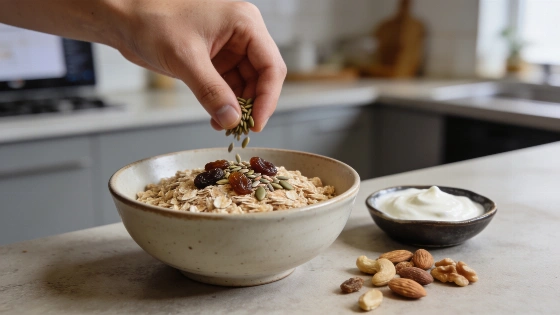
Raisin Bran has 7 grams of fiber and 5 grams of protein per cup. It also has 18 grams of total sugar, including 9 grams of added sugar. Lauren O'Connor, M.S., RDN, recommends watching the portion and mixing it with a less-sweet, high-fiber cereal such as Bran Flakes, Fiber One or rolled oats. Nuts and seeds add fiber, protein and unsaturated fats. Plain yogurt or dairy or soy milk can round out the meal. You could also add raisins separately to Bran Flakes. The raisins in Raisin Bran are coated in sugar syrup.
Check the portion. A serving of Raisin Bran has 190 calories, 47 grams of carbohydrates and 210 milligrams of sodium. Its sugar content makes portion size and pairings worth a closer look. Fiber and protein can help with fullness. For some people, a high intake of sugars and refined carbohydrates may contribute to higher triglycerides. The overall diet and individual health factors matter, too.
For a practical choice, compare serving size, fiber, added sugar, calories and sodium. Then think about what you will add to the bowl. More protein does not automatically make a cereal the best fit for everyone. Terms such as "heart healthy" or "whole grain" do not replace the numbers on the panel. The same label-first approach applies to nutrition shakes and powders. Check the serving amount and disclosed ingredients, and treat broad claims as something to verify, not proof of a health effect. The takeaway is not that one cereal lowers triglycerides. A higher-fiber breakfast with less added sugar can support a broader dietary approach.