
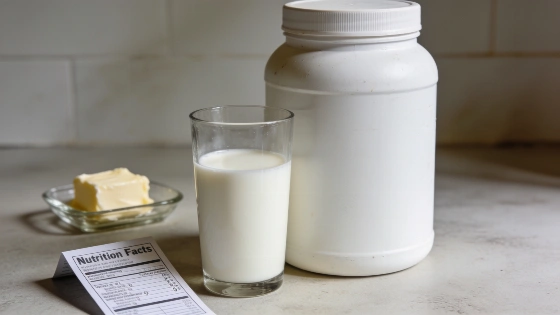
Milk and meat from ruminant animals contain small amounts of naturally occurring trans fats. Industrial trans fats, by contrast, were mainly made by partially hydrogenating vegetable oils. Research suggests the two types may affect health differently. The available study details do not show that natural dairy trans fats are harmless or beneficial.
The distinction matters when reading nutrition research or choosing a product. Industrial trans fats are linked to higher LDL and lower HDL cholesterol, and their use in the U.S. food supply has been substantially restricted. For shake shoppers, the question is not just whether a product contains dairy. Check what its Nutrition Facts panel and ingredient list disclose. Start with the label.
For a shake, check the serving size, total fat and trans fat on the Nutrition Facts panel, then read the ingredient list. Whey concentrate, whey isolate and milk-derived ingredients can differ in fat content; the product's own label is the useful comparison.
Why the distinction matters
The World Health Organization estimates that industrial trans fat consumption is linked to more than 278,000 deaths worldwide each year. It recommends keeping intake below 1% of total energy. Its policy approaches include limiting trans fats to 2 grams per 100 grams of total fat or eliminating partially hydrogenated oils. These recommendations apply to trans fats at the population level. They do not show that every naturally occurring dairy trans fat has the same risk profile as industrial trans fat. The evidence has limits.
The related research report shows why dietary findings need to be judged by what a study actually measured. Here, the reported distinction is a research finding, not proof that dairy trans fats carry no risk. Broader reviews indexed in PubMed literature can help put the evidence in context. They cannot replace the methods and results of the specific study being discussed.
Claims Check: The FDA determined that partially hydrogenated oils are no longer generally recognized as safe for use in human food, with limited exceptions. That regulatory action addresses industrial oils; it does not establish that naturally occurring dairy trans fats are risk-free, or that a dairy-based shake has a heart-health benefit.
What shake shoppers should take from it
A dairy-based shake may contain whey or other milk-derived ingredients. A plant-based powder contains no dairy fat unless the formula includes a dairy ingredient. Whey concentrate and whey isolate do not tell you the fat content of a finished product. Formulas vary. Compare serving size, total fat and trans fat on the Nutrition Facts panel instead of guessing from the protein source. The ingredient list can also show which oils the formula uses.
Do not assume that "natural," "clean" or "dairy-based" means a product is healthier. A low trans-fat number is just one label detail. Protein per serving, calories, added sugars, allergens and cost per serving may also matter to a shopper's goals. If a product uses a proprietary blend, the total blend weight does not show the exact amount of each component. That means shoppers cannot check claims about a particular active ingredient against a disclosed dose.
The evidence supports a careful distinction, not a blanket endorsement or warning about dairy. Industrial trans fats raise a well-established public-health concern and have been targeted by policy. The reported findings on natural dairy trans fats do not show that they are safe or beneficial. For consumers comparing shakes, read the full label. Do not treat a marketing claim or a single study as a substitute for the product's disclosed formulation and the broader evidence.