
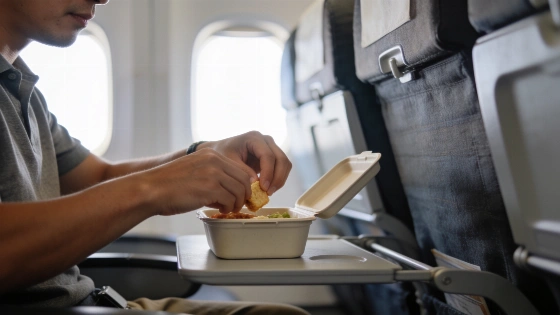
Weather can disrupt meal and snack service, Southwest flight attendant Taylor Stetka says. If turbulence interrupts service, a hungry passenger may not get a chance to eat. Keep a backup close.
Dietitians and flight attendants recommend boarding comfortably fed and carrying a snack. In the U.S., federal delay rules do not give passengers a general right to food or drinks during a flight. What an airline provides often depends on its own customer service policy. A backup helps even when a carrier usually serves food.
For any packaged shake, compare protein grams with calories per labeled serving, then check serving size and added sugars. A protein-to-calorie ratio is a comparison tool-not proof that a drink is a complete meal.
Plan for food before the cabin service
Dietitian Meahgan Ormsby says to start fueling before boarding and keep eating through the travel day. Starting a flight underfueled can affect energy, concentration, mood and patience, she says. Hunger can also make it harder to rest when the body is signaling hunger rather than tiredness.
Eating before the flight gives travelers more choice than relying on whatever comes around on the cart. Dietitian Bonnie Taub-Dix recommends a meal or snack with protein, healthy fat and fiber to help you feel satisfied without getting overly full. If a ready-to-drink shake or powder is your backup, read the Nutrition Facts panel. Compare calories, protein, fiber and added sugars per serving. Check whether the serving listed is one bottle or only part of it. The FDA label guide explains how to read those values.
Protein powder is not automatically a meal replacement. Whey, casein, soy and plant proteins such as pea or rice differ in source and formulation. Check the allergen statement and the actual amount of protein instead of relying on front-of-pack language. For powders, compare scoop weight in grams, calories, added sugar and cost per serving, not just the tub price. Sweeteners and added fibers such as inulin can affect taste or digestive comfort for some people. A product may list the total weight of a proprietary blend without disclosing the amount of each ingredient.
A packed snack can help if turbulence delays the crew. It cannot guarantee you will avoid discomfort, but it gives you another option when onboard food is out of reach. Passenger-care rules also depend on where a flight is covered. UK rules generally require meals and refreshments after qualifying delays, with care thresholds that vary by flight distance. Brazil's updated rules retain meal assistance after two hours, plus accommodation and transport when an overnight stay is needed after four hours. These rules do not mean food will be available the moment you feel hungry.
What flight attendants see in the cabin
Southwest flight attendant Tatiana Laibinis says half of the medical incidents she has handled onboard involved passengers who lacked nutrition and hydration before boarding. She recalls passengers fainting and telling her, "This has never happened to me." Her account is firsthand experience. It does not show that skipping a meal causes every in-flight fainting episode.
Ormsby says underfueling can affect energy and mood. Laibinis's account offers another reason to prepare. People with blood sugar concerns, anxiety or air sickness may want to pay close attention to eating before travel and following their clinician's plan. Guidance for someone treating hypoglycemia differs from routine snack planning. NHS guidance recommends 15-20 grams of fast-acting carbohydrate, then waiting 10-15 minutes and repeating if needed. If a meal is not soon, it advises another snack with 15-20 grams of slower-acting carbohydrate. This guidance is for a specific condition, not a target for every traveler.
Make the travel day easier to manage
Aim to board comfortably satisfied, not stuffed or starving. Ormsby puts that point at about a 7 on a 1-to-10 hunger/fullness scale. You can also buy airport food to take onboard. Packed snacks with carbohydrates, protein and fat can help with hunger later. If you choose a bar or shake, check for relevant allergens such as dairy, soy, gluten or nuts. Make sure the serving and sugar content fit your needs. The words "meal replacement," "detox" or "immune support" do not tell you what the product provides.
Food is only one part of the routine. Ormsby recommends drinking water throughout the travel day and bringing an empty reusable bottle through security to fill before boarding. Walking in the terminal and moving a little in your seat can support circulation. Stetka suggests tracing the ABCs with your feet. Flight attendant Tatiana Laibinis also recommends using the restroom before boarding. Tarmac delays can extend the wait.
Keep the plan simple: eat a meal or snack, carry a backup and drink water before thirst sets in. Do not count on the onboard cart arriving at the right moment. A snack is a practical backup, not a substitute for individual medical advice or a guarantee that you will feel well. Preparation gives travelers more control over comfort and energy.