
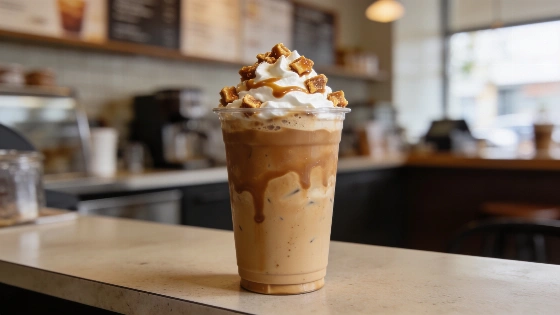
A grande Caramel Ribbon Crunch Frappuccino has 470 calories, 60 grams of total sugar and 14 grams of saturated fat. Four dietitians asked to name a Starbucks drink they would steer people away from chose this one.
One treat does not ruin a balanced diet. The concern is that customers may mistake it for everyday coffee, when its nutrition profile is closer to a dessert. Starbucks lists the drink in its U.S. nutrition information, where customers can check current figures for a specific size and order.
A grande provides 5 grams of protein for 470 calories-about 1 gram of protein per 100 calories-and no dietary fiber. That makes it a very different nutritional proposition from a protein-focused shake or meal replacement.
What adds up in one grande
The 16-ounce drink also contains 22 grams of total fat, 65 grams of carbohydrates and 5 grams of protein. It has no dietary fiber. Its sugar comes from several ingredients, including Frappuccino syrup, caramel sauces, vanilla syrup in the whipped cream and the caramel-sugar topping. Registered dietitian Johannah Katz says some sugar is naturally occurring milk sugar. The drink also has several sources of added sugar.
Total sugar and added sugar are not the same. Total sugars include sugars that occur naturally, such as lactose in milk. The FDA's added-sugars guidance explains the difference. The American Heart Association recommends daily limits of 36 grams for men and 25 grams for women. Those are recommended limits, not a measure of how much of this drink's total sugar is added.
Fourteen grams of saturated fat is about 70% of the Daily Value, based on a 20-gram daily reference value. Whipped cream and cream-based caramel sauces contribute to the drink's richness. Dietitian Laura Burak describes it as one of the menu's highest-calorie choices and one of its highest in added sugar. The FDA label guide explains how to read Daily Values on packaged foods. The label needs context.
Claims Check: Total sugars and added sugars are not interchangeable; milk contributes naturally occurring lactose, while syrups and toppings can add sugars. Read the figures together with serving size and ingredients, and do not infer an exact added-sugar amount from total sugars alone.
With little protein and no fiber, a 470-calorie drink may not keep some customers full as long as they expect a snack or meal to. The protein-to-calorie comparison describes the label. It is not a formal measure of overall nutritional quality.
Keep the flavor and change the order
A grande Sugar-Free Caramel Protein Latte made with 2% milk has a different nutrition profile: 230 calories, 15 grams of sugar from lactose, no added sugar and 27 grams of protein. A grande Iced Caramel Macchiato with 2% milk has about 250 calories, 33 grams of sugar and 10 grams of protein. Asking for one pump of vanilla and light caramel can lower its sugar further. Menu figures and customizations can change, so check the current listing before ordering.
Other options include a grande Caffè Latte with nonfat milk, at about 130 calories, 18 grams of sugar and 13 grams of protein. Cold brew with a splash of milk and a light pump of sugar-free vanilla is another choice. Most of the latte's sugar comes from lactose in the milk. Cold brew has about 5 calories on its own and under 50 calories with the described additions.
The same attention to food choices applies beyond coffee. Dietitians' prepared meal analysis looks at ingredient quality and variety in ready-to-eat options.
Customers who still want a Frappuccino can ask for nonfat milk, fewer syrup pumps and no whipped cream. Revised nutrition figures for those changes are not available here. Samantha Thorp, M.S., M.P.H., RDN, says she would not choose a Frappuccino as an everyday coffee order. Lakelyn Lumpkin, M.P.H., RD, LDN, says Starbucks drinks do not need to be avoided entirely.
Third-party trackers list Caramel Frappuccino-style drinks on current menus in several international markets. Those listings do not confirm availability or nutrition figures at every location. The available information supports a nutrition comparison, not a specific product controversy or a reported recall.
Frequency matters more than food morality. The Caramel Ribbon Crunch is a high-sugar, high-saturated-fat treat, not a routine coffee choice. Enjoy it occasionally if it is the drink you want. For a regular order, a lower-sugar or higher-protein alternative may suit you better.