
Muscle mass can decline with age. An often-cited estimate puts the loss at roughly 3% to 8% per decade, though the rate varies and does not predict what will happen to any one person.
For adults over 60, maintaining strength, balance and the ability to manage daily activities can be a more useful goal than chasing a more defined look. Resistance training, cardiovascular activity and a balanced diet can all support overall health. Consistency matters.
A shake is optional, not a shortcut. When comparing protein powders or ready-to-drink shakes, check the serving size, protein grams, calories, added sugars, allergens and cost per serving. For meal replacements, check whether the Nutrition Facts panel shows a broader mix of nutrients. A high protein number alone does not make a product a complete meal.
A useful label comparison: divide protein grams by calories, then compare products using the same serving basis. This shows protein relative to energy, but does not measure protein quality or make a shake a meal replacement.
Start with controlled movements. Use a sturdy chair, counter or wall for support when needed. The CDC's older-adult activity guidelines recommend that adults 65 and older aim for at least 150 minutes of moderate-intensity aerobic activity a week, or 75 minutes of vigorous activity. They also recommend muscle-strengthening activity at least two days a week that works all major muscle groups. Balance activity matters too, particularly for people concerned about falls. If you have a health condition, pain or a history of falls, ask a health professional how to adapt a routine.
Build lower-body strength and control
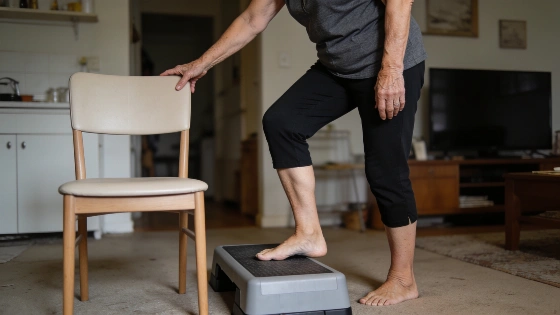
Step-ups: Stand facing a low step, with a sturdy support nearby. Place one foot flat on the step and press through it to bring your body up. Keep your knee aligned with your toes. Bring the other foot up, then lower one foot at a time with control. Do 8 to 12 repetitions, switch sides and complete 2 to 3 sets per leg. As your strength and balance improve, try a slightly higher step or hold light weights.
Body-weight squats: Stand with your feet about shoulder-width apart and your toes turned slightly outward. Send your hips back as if sitting into a chair. Bend your knees while keeping your heels down, then press through your heels to stand. Lower only as far as feels comfortable. Keep your knees aligned with your toes. Do 8 to 12 repetitions for 2 to 3 sets. Hold a sturdy chair for support or add dumbbells to increase the challenge.
Claims Check: A shake marketed for 'tone,' 'detox' or 'metabolism support' does not establish that it will build strength or change body composition. Look for disclosed ingredient amounts and evaluate the product's nutrition panel; FDA rules distinguish permissible structure/function claims from claims to diagnose, treat, cure or prevent disease.
Step-ups and squats work the legs and glutes. They also rehearse actions used to climb steps and rise from a chair.
The FDA's supplement claims guidance explains that marketing language is not proof of a health outcome. A proprietary blend can make label comparisons harder: it lists a combined weight but does not show the amount of each ingredient. Compare the actual serving size and price per serving. Check whether sweeteners, fibers such as inulin, or thickeners such as xanthan gum suit your preferences and tolerance.
Strengthen the upper body at home
Rows: Secure a resistance band to a sturdy, stationary object and hold one end in each hand. Step back until the band has some tension. Relax your shoulders and pull your hands toward your waist, with your elbows close to your body. Pause briefly, then straighten your arms slowly. Do 10 to 12 repetitions for 2 to 3 sets. You can also sit with your legs extended and loop the band around the soles of your feet. Dumbbells or cans work for rows, too.
Wall pushups: Place your palms on a wall at about shoulder height, slightly wider than shoulder-width apart. Step back so your body forms a straight line. Bend your elbows to bring your chest toward the wall, then press back. Keep your core engaged and do not let your hips drop. Do 10 to 12 repetitions for 2 to 3 sets. Stand closer to make the movement easier or farther away to make it harder.
Use support freely.
Add focused hip work
Standing hip extension: Hold a counter, chair or wall for balance. Shift your weight onto one leg. Keep the other leg straight and move it slowly backward without leaning your upper body forward. Squeeze the glute, then lower the leg with control. Do 10 to 12 repetitions on each side for 2 to 3 sets.
Standing hip abduction: Hold a stable support and shift your weight onto one leg. Keep your hips level and facing forward as you move the other straight leg out to the side. Do not lean your torso. Lower the leg slowly. After 10 to 12 repetitions, switch sides. Complete 2 to 3 sets per leg. An ankle resistance band or ankle weights can add challenge.
Choose a resistance that makes the final repetitions challenging but lets you keep good form. Stop if you feel sharp pain, dizziness or unusual shortness of breath. When an exercise becomes manageable, progress gradually by adding repetitions, resistance or step height. Strength work and balance training support everyday function. Safe, consistent movement matters more than visual definition.
If you use a protein shake for convenience, treat it as one possible way to add protein, not as a replacement for a varied diet or a strength routine. Compare protein grams, calories and added sugars per serving. Check the ingredient and allergen statements, and calculate the cost per serving instead of relying on front-of-pack claims. Whey and plant proteins differ in source and amino-acid composition. The best fit depends on dietary needs, tolerance, preference and the full label.