
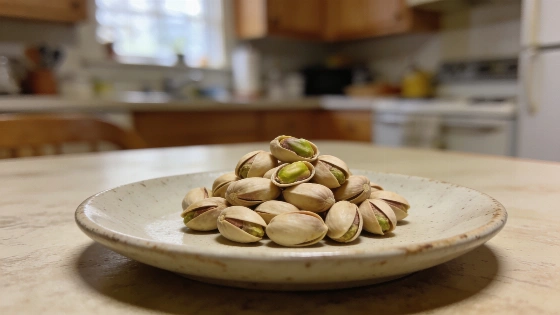
A narrative review in Nutrition Research Reviews examines how pistachio nutrients and plant compounds might relate to sleep quality, the sleep-wake cycle, and how quickly people fall asleep or how long they stay asleep. It does not show that eating pistachios improves sleep in people. Pistachios remain a research topic, not a proven sleep aid.
Sleep concerns are common, but the measures are not interchangeable. U.S. data cited in recent reporting found that 15.4% of adults said they had trouble falling asleep most days or every day. That figure is not the share of adults who sleep fewer than seven hours, or the prevalence of diagnosed insomnia. Adults are generally advised to aim for seven to nine hours of sleep. The NIH insomnia overview describes insomnia as an ongoing sleep problem, not simply one short night.
No clinically established pistachio serving or nutrient dose has been shown to improve sleep. A food label can describe what a serving contains; it cannot establish a sleep benefit that has not been demonstrated in human trials.
Why researchers are studying the whole food
The review reports about 71 milligrams of tryptophan in a one-ounce serving of pistachios. The body uses tryptophan in pathways that produce serotonin and melatonin. Vitamin B6 and magnesium also have roles in normal body processes. Those roles do not show that the amounts in one serving work as a sleep treatment. The review has not established a clinically effective dose.
Pistachios also contain phytomelatonin, a plant form of melatonin. But researchers have not established how much people absorb or what happens after they eat pistachios. A number on a Nutrition Facts panel is not a tested dose for a sleep outcome. Whole pistachios also differ from powders or blends, which may have other serving sizes, added ingredients and claims.
The review does not focus on a single "sleep nutrient." It looks at the pistachio food matrix: the mix of nutrients and plant compounds in a whole food. Laboratory studies that simulated digestion and fermentation found that gut microbes can ferment pistachio fiber and transform polyphenols. The process may also contribute to a longer release of phytomelatonin. These lab results do not show that people sleep better.
Claims Check: A biological pathway or a laboratory result is not proof that a food improves sleep. FDA rules for dietary supplement structure/function claims do not turn a marketing statement into clinical evidence, and ordinary pistachios are a food-not a sleep supplement.
One randomized crossover study involved 51 adults with prediabetes. Researchers compared an evening portion of about 57 grams of pistachios with a usual carbohydrate snack over two 12-week periods. The study examined gut microbiota, not sleep quality or duration. It cannot show that pistachios help people fall asleep or stay asleep.
A 2021 meta-analysis of 13 randomized trials found no overall statistically significant effect of pistachio consumption on inflammation markers, including C-reactive protein and TNF-α. That finding does not show a sleep benefit either.
Sleep and food choices can affect everyday life. A related couples study examined how partners' sleep may affect healthy eating efforts. It does not show that pistachios change sleep.
Human evidence is still the test
The review calls for randomized controlled trials that measure whole-pistachio intake, dose-response relationships, melatonin levels, sleep outcomes and the bioavailability of relevant compounds. Researchers also need to test whether pistachio variety, growing conditions or processing affect nutrient and bioactive content.
American Pistachio Growers is supporting several university-led human clinical studies on pistachios and sleep. Results are not yet available. The review received support in part from American Pistachio Growers and the National Institutes of Health. Readers assessing the research should know who funded it.
For shoppers, the takeaway is simple: pistachios can be part of a diet, but current evidence does not support buying them as a sleep remedy. Check serving size, calories, added sugars, sodium and ingredient lists when comparing packaged pistachios or pistachio-based mixes. Treat claims about "sleep," "gut health" or similar benefits with care. A nutrient or lab finding is not the same as human evidence.
Trials still need to measure meaningful sleep outcomes. Until then, pistachios are a research question, not a promise of better rest or a substitute for care for persistent sleep problems.