
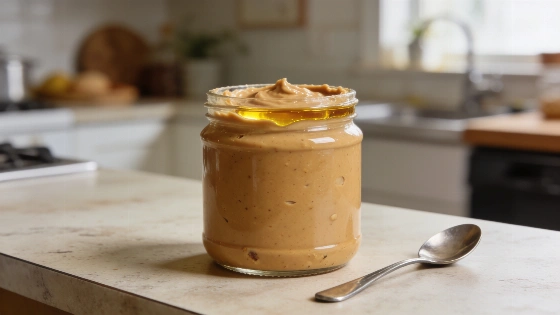
In natural peanut butter, oil released during grinding can rise to the surface. Registered dietitian Theresa DeLorenzo says some no-stir versions use added ingredients to keep the mixture uniform.
That makes texture a useful shopping clue, but not a nutrition scorecard. A separated jar does not tell you how much added sugar or saturated fat it contains. Texture is one clue.
A retailer-listed Jif label provides a useful example: it lists 16 g total fat and 3.5 g saturated fat per serving, along with fully hydrogenated rapeseed and soybean oils. Check the current package for serving details and ingredients, since labels can change.
What the oil separation reveals
Stabilizers and texturizers keep some peanut butters smooth and stop the oil from separating. The FDA's food-ingredient records list permitted uses for certain ingredients in peanut butter. Those uses can come with conditions, including limits under good manufacturing practice. Their presence explains a formulation choice. It does not, by itself, show whether a product is nutritious or suits a particular shopper.
In the United States, the FDA identity standard generally requires peanut butter to contain at least 90% peanut ingredients. Products that do not meet the standard may be labeled as a peanut spread. It governs the name, not health. Check the ingredient list and Nutrition Facts panel on the specific jar.
Claims Check: A stabilizer's permitted use is not proof that a product is healthier or less healthy overall. The FDA's ingredient records describe uses and conditions; shoppers still need to compare the full ingredient list, added sugars and saturated fat on the label.
Fully and partially hydrogenated oils are not the same. Fully hydrogenated oils are mainly a source of saturated fat. Partially hydrogenated oils were the main source of industrial trans fat in foods. The FDA determined that partially hydrogenated oils were no longer generally recognized as safe. The phase-out deadline for most uses was in 2018. That change reduced one concern, but saturated fat still matters. The FDA's trans fat overview explains the regulatory background.
Check for sweeteners and serving size
Flavored varieties, including honey-roasted or dessert-inspired peanut butters, may contain added sugar. Compare added sugars, saturated fat, serving size and the ingredient list. Words such as "natural" or "no-stir" are not enough. A short ingredient list can explain how a product is made. The Nutrition Facts panel lets you compare amounts.
Powdered peanut products are a separate category, not a one-to-one substitute for jarred peanut butter. Processing changes their fat and calorie profile. Compare serving weights, calories, protein and added sugars on each product's label. A scoop and a spoonful may not be nutritionally equivalent.
Shake Nutrition has covered saturated-fat swaps in a different context. Here, the choice is between peanut butter formulations.
If stirring is the sticking point, DeLorenzo suggests storing the jar upside down in the refrigerator. The oil can then solidify. Oil separation is not a reason to dismiss a jar. It can point to a formulation without certain stabilizers, but the ingredient list and Nutrition Facts panel offer a better basis for choosing.