
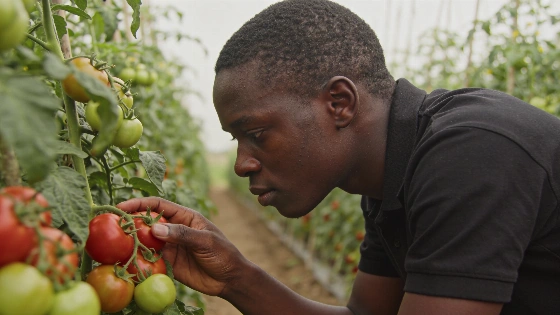
At a media briefing in Accra ahead of World Food Day 2026, the Food and Agriculture Organization, or FAO, urged Ghana to use research and technology to strengthen food security. The country spends significant amounts importing food, including tomatoes and chicken. FAO says innovation could help improve local production. But more output does not guarantee affordable food, access for consumers or a varied diet. Output alone falls short.
The briefing took place under the theme "Innovate today. Nourish tomorrow." The government's Feed Ghana programme reports that rice self-sufficiency rose from 42% to 56%, while poultry products rose from 5% to 21% in the programme's first 17 months. A second phase, announced for October 2026, is expected to focus on storage, transport, processing and marketing.
Feed Ghana representatives report that maize production has exceeded domestic consumption. Tomato growers, however, have faced procurement and reliable-market challenges despite strong harvests-a reminder that production figures do not show whether food can reach buyers.
Researchers test AI and local foods
Dr Meshack Malo, FAO Representative in Ghana, said agriculture gives young people a chance to develop solutions to food challenges. He urged them to pursue ideas in the sector and seek available financing. "The agriculture sector offers hope, but we believe that we can work together through leveraging on science, leveraging on technology, leveraging on AI in order to make this sector better, to be able to nourish tomorrow," Dr Malo said.
Dr Malo has also pointed to AI, data and accessible technologies as tools that could raise productivity and cut losses. An April 2025 analysis he cited found that about 2.38 million people in Ghana were unsure they could provide their next meal. The need is clear.
Researchers are also using technology to study nutrition. A digital tool's value depends on what it has been tested to measure, and who took part.
Dr Gloria Folson, Head of the Department of Nutrition, Diet and Metabolic Sciences at the Noguchi Memorial Institute for Medical Research, said researchers are using AI to assess diets. She said validation of the FRANI mobile app showed promising results in estimating nutrient intake among school-age children and adolescent girls aged 10 to 19. "Our validation of the FRANI mobile app has shown that AI can accurately estimate nutrient intake amongst school-age children and adolescent girls between 10 and 19," Dr Folson said.
Claims Check: promising validation in a defined group is an encouraging research result, not proof that an app measures every nutrient accurately for every age group or eating pattern. The reported finding concerns estimates among school-age children and adolescent girls aged 10-19; broader use requires evidence in other populations and settings.
Making more of local food
Research into Ghana's school feeding programme has identified ways to improve meals with eggs, textured soy protein and other locally available foods. Similar care matters when shoppers compare packaged shakes or protein powders. They should check serving size, protein amount and source, calories, added sugars and allergens. Broad claims such as "complete nutrition" or "gut health" do not tell the whole story. On products sold in the United States, the Nutrition Facts label can help shoppers compare calories and nutrients per serving. Ingredient names and a clear serving size also matter when assessing a blend.
Food composition matters too, but values depend on the food and how it is prepared. The USDA FoodData Central database lists nutrient information for foods. It is not a substitute for a product's own label, nor does it guarantee that a packaged product matches a whole-food reference.
Chef Joseph Wilson-Tetteh, President of the Hospitality Alliance of Ghana, called for sustainable food practices that cut waste and make fuller use of available ingredients. He pointed to chicken and fish parts often discarded in Ghana but used in meals in other cultures. "Why can't we also look at sustainable food practices and reduce waste?" he asked.
Government budget figures show the scale of the effort. The 2025 budget provided 1.5 billion Ghanaian cedis for agricultural initiatives. The 2026 budget allocated 245 million cedis for food security and agro-industrial value chains, including Feed Ghana, grain and vegetable production, and the Nkoko Nkitinkiti livestock programme. Funding and production targets are only inputs. Distribution, processing and access determine whether extra supply reaches households.
Trade figures point to wider economic pressure, but do not identify specific food imports. Ghana's total goods imports rose to 94.7 billion cedis in April to June 2026, from 64.2 billion in the first quarter. The trade surplus fell 70.1% to 13.8 billion cedis. These totals do not show a specific change in tomato or chicken imports.
Government, researchers, businesses and young innovators will need to work together on sustainable production, nutrition and a more resilient food system. Practical results will show whether Ghana's innovation agenda is working: more effective local production, less waste, reliable routes to market and nutrition research that can guide decisions. The details matter.