
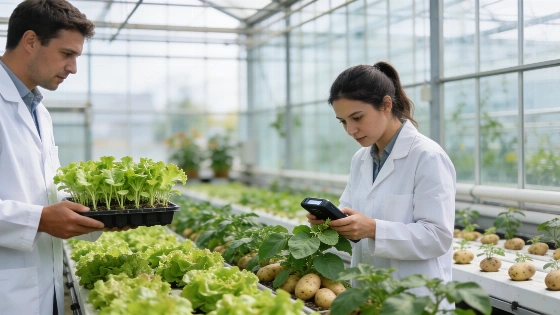
Québec's farms are getting a shot in the arm. Two teams from the Department of Plant Science have won funding from Génome Québec's Genomics Integration Program. Fourteen projects got a share of almost $4.2 million in public and private money. Lettuce and potato breeding are at the heart of two of the biggest projects.
Lettuce growers know what's at stake. Jean-Benoit Charron, Associate Professor, is working with Fondation Laitue to speed up the search for lettuce that can handle disease and changing weather. His team will grow, test, and sequence over 200 different lettuce lines. They're looking for genetic markers that point to resistance and adaptability. The aim is simple: give Québec's lettuce producers crops that can survive as the climate shifts.
Genomics-driven crop research is now funded at levels comparable to major product development in the supplement industry, with individual projects reaching up to CA$1.5 million and total investments in the multi-million dollar range.
Potato growers face a different problem. Martina Stromvik, also an Associate Professor in the Department of Plant Science, is teaming up with Progest2001 inc. and Agriculture and Agri-Food Canada. They want to find out which viral strains are hurting potato yields in Québec and Eastern Canada. Stromvik's group won't just diagnose the problem. They'll also search for new resistance genes in wild potato relatives. The goal is to help breed virus-resistant potatoes that can protect future harvests.
These aren't just academic projects. Genomics research in staple crops like lettuce and potatoes has a direct impact on food security, farm profits, and how well Québec's agriculture can handle tough times. By zeroing in on disease resistance and climate adaptation, both teams are taking on the biggest threats local growers face.
Génome Québec's support shows there's a real push for applied genomics in the biofood sector. With focused funding and a drive for practical results, this round could change how research leads to better crops in the field. For growers and shoppers, the message is clear: the future of Québec's food supply depends on science that works where it counts-in the field.
Claims Check: While many nutrition shake brands highlight 'immune support' or 'resilience' on their labels, regulatory authorities such as the FDA require that such claims be substantiated by clinical evidence and not imply disease prevention unless supported by robust data. Crop genomics research, like these lettuce and potato projects, provides foundational science that can eventually inform ingredient sourcing and label transparency in functional foods.
For people buying nutrition shakes, this matters. The quality and resilience of plant-based ingredients-lettuce, potato, or pea protein-start with farm science. As genomics-based breeding moves forward, expect clearer ingredient sourcing and maybe better nutrient profiles in future products. For now, label readers should check Supplement Facts panels for protein source, amino acid profile, and third-party certifications. These are still the best ways to judge product quality and safety. For more on ingredient standards, the USDA and NSF certification offer independent benchmarks for food quality and label accuracy.