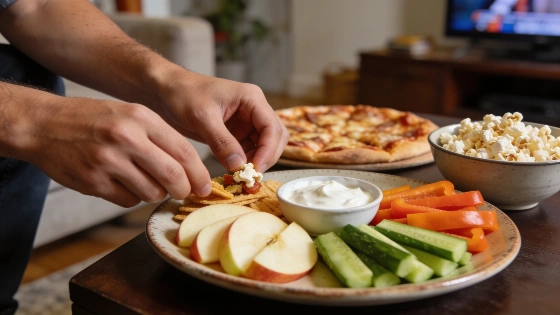
A plate can hold pizza alongside fruit or vegetables, rather than turning the snack table into an all-or-nothing test. Registered dietitian and personal trainer Alissa Palladino recommends choosing the snacks you enjoy, serving a reasonable portion and adding foods with protein or fiber.
The aim is a satisfying plate, not a table of forbidden foods. That approach tracks with the Dietary Guidelines for Americans, which emphasize a varied eating pattern and nutrient-dense foods rather than banning individual dishes. The guidelines name eggs and poultry as examples of high-quality protein foods. Seafood and meat are also included, as summarized by the National Center for Health Statistics.
Choose favorites, then decide on portions.
If pizza is the pick, Palladino suggests one or two slices alongside fruit or vegetables. For chips and dip, put a portion on a plate instead of eating from the bag or serving bowl. The same approach works for wings or nachos: serve some, enjoy them, then check whether you are still hungry.
A little planning can make grazing more intentional. Eat a balanced meal beforehand if you expect to arrive hungry. You could also bring a fruit- or vegetable-based dish to share, or decide which foods matter most before the game starts. Palladino calls this making a "game plan" for what and how much to eat.
When hunger hits, notice what sounds satisfying. Fish with brown rice and vegetables can make a balanced option; fruit with string cheese is another. Those choices may help distinguish physical hunger from an urge prompted by the setting. If you recently ate and only party snacks appeal, the surroundings may be driving that urge. Palladino says situational hunger is normal. The point is to respond mindfully, not to forbid eating. A similar practical check-in appears in this snack-planning guide.
Build the spread around filling options.
Set out fruit and vegetables to round out richer snacks. Carrots and cucumbers work well, as do bell peppers and cherry tomatoes. Sugar snap peas offer another option; grapes or berries can add fruit. Palladino also suggests dips that contribute protein or fiber, including nonfat Greek yogurt and hummus. Guacamole can add healthy fats.
Whole grain or bean-based chips and crackers can contribute fiber. For more filling choices, Palladino suggests nuts or roasted chickpeas. Edamame is another option. Cheese and lower-sodium deli turkey or ham can round out the spread.
Produce adds variety and nutrients, but it does not cancel out calories in richer snacks. CDC guidance describes daily targets of about two servings of fruit and three servings of vegetables. In its 2025 survey of high school students, 38.9% said they ate fruit at least once a day; 62.5% reported eating vegetables at least once a day. The survey also found that 28% ate fruit at least twice a day, while 16% ate vegetables at least three times a day. These are frequency measures, not serving-size estimates, according to the CDC Youth Risk Behavior Survey.
For a long afternoon of grazing, a large tray of cut produce or air-popped popcorn can make a substantial snack. Palladino says three cups of popcorn have the same calories as a small handful of chips. The whole-grain corn also provides fiber. For packaged popcorn, she recommends checking for a simple ingredient list and avoiding varieties especially high in added sugar or saturated fat.
Water or another unsweetened drink is a straightforward choice alongside game-day snacks. In the CDC's 2025 survey, 58.3% of high school students reported drinking at least three glasses of plain water a day. Another 30.4% reported not drinking soda. The survey measures reported habits; it does not test whether a particular snack or drink choice causes weight loss.
Five recipes for the game-day table
Palladino selected these Healthline recipes because they pair colorful produce with protein or fat. The Peanut Butter Yogurt Dip recipe combines apples with peanut butter and Greek yogurt.