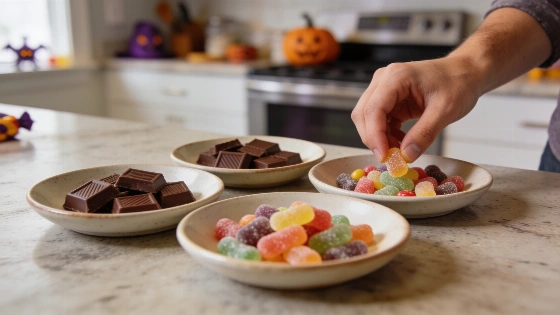
A 50-gram serving of Sour Patch Kids contains 38 grams of added sugar. The same weight of SmartSweets Tropical Sours has 3 grams of total sugar and no added sugar.
That difference jumped out during my Halloween candy taste test. I'm in my late 50s and still love sweets. Harken and Unreal both satisfied me, but SmartSweets was my favorite over Sour Patch Kids.
What to check on a "healthier" candy label
Molly Kimball, R.D., host of Fueled Wellness + Nutrition with Molly, says the focus on added sugar can create a health halo. Removing an ingredient does not automatically make candy nourishing. The same goes for adding protein or fiber.
Kimball recommends checking serving size and added sugar. She suggests looking for no more than 5 grams of added sugar per serving, while cautioning that "no added sugar" does not always mean sugar-free. The American Heart Association recommends limiting added sugar to about 25 grams a day for most women, roughly 6 teaspoons. Its recommendation for men is 36 grams, or about 9 teaspoons. Those amounts equal approximately 100 calories for women and 150 for men.
The FDA's Nutrition Facts label sets a Daily Value of 50 grams of added sugar, based on a 2,000-calorie diet. The agency treats that figure as a labeling reference, not an individual daily target. Added sugars appear separately from total sugars, which can include sugar naturally present in foods such as fruit and plain milk, as explained in the FDA's label guidance. A 50-gram serving with 38 grams of added sugar supplies about 152 calories from sugar alone. That exceeds the AHA's daily recommendation for most women and equals about 76% of the FDA label's Daily Value.
Protein claims deserve a closer look. Kimball points out that one egg has 6 to 7 grams of protein, so a candy bar with 5 grams is not a particularly impressive source. She adds that every little bit can help someone trying to increase protein intake.
Some sugar alcohols can cause digestive discomfort. Maltitol or sorbitol may bring gas or bloating for some people. Diarrhea is another possible effect. Erythritol and xylitol work for some people in small amounts, though tolerance varies. The NHS also says sugar-free products with sweeteners ending in "-ol" can contribute to gas and bloating. The effect depends on the sweetener and the amount, as well as a person's tolerance. Less sugar does not necessarily mean fewer digestive symptoms.
Packaging language matters. A "less sugar" product can still contain 10 or more grams of added sugar. "No added sugar" does not mean a product has no total sugar. And "less sugar" compares a product with something else; it does not guarantee a low amount. Kimball also suggests noticing how a sweet affects cravings. Pay attention to mood, too, and to energy. She calls the less welcome effect a "glucose and energy rollercoaster."
For another perspective on candy portions and fullness, a look at peanut candy satiety noted that peanuts may make some sweets feel more filling. Serving size still matters, as does added sugar.
Three candy swaps under the microscope
Harken's first five ingredients are tapioca fiber, coconut, dates, almonds, and sunchokes. Mounds starts with corn syrup. Coconut comes next, followed by sugar, chocolate, and cocoa. Kimball says the bars have around the same calories, while Harken has about half the sugar and four times the fiber. Mounds tasted more traditionally chocolatey to me. I enjoyed Harken's coconut flavor and its sweetness, and appreciated that it is vegan.
Unreal uses organic ingredients, and its cup is smaller. Kimball says, "Unreal still uses cane sugar. What changes is the amount, simply because the pieces are a different size." Unreal also uses fair-trade ingredients and is certified vegan. I preferred its more nuanced flavor to the Reese's, which left an overly sweet aftertaste. The smaller cup satisfied me.
Kimball calls the difference "huge, huge" and says 40 grams of added sugar is roughly 10 teaspoons. Sour Patch Kids packaging lists a 25-gram serving. SmartSweets lists 50 grams. The first three Sour Patch Kids ingredients are sugar, invert sugar, and corn syrup. SmartSweets starts with isomalto-oligosaccharides. Chicory root fiber comes next, followed by water.
SmartSweets comes in pineapple orange, lime twist, and tropical punch flavors. I found it about 98% as tasty as Sour Patch Kids. It had about 10% of the sugar and some fiber.