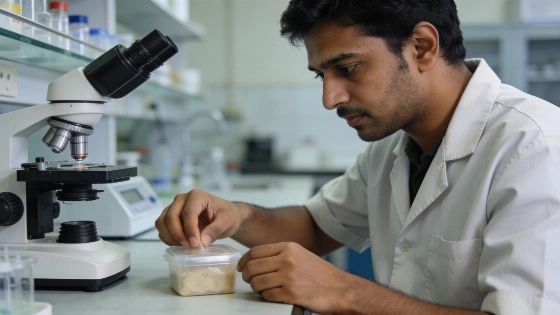
At a laboratory in Chandigarh, researchers are preparing to test how food might affect the body in space-like conditions. Their work will examine changes in metabolism, gut microbiota and bone health. No final astronaut diet has been established.
The ISRO-funded collaboration includes the Postgraduate Institute of Medical Education and Research in Chandigarh and the Central Food Technological Research Institute in Mysore. IIT Ropar is also part of the project. The work remains at the laboratory and simulation stage, with initial food studies planned in animals.
This research has not specified a food product, serving size, nutrient panel or active ingredient dosage. Without those details, there is no formulation to compare by protein per serving, calories, added sugars or cost per scoop.
Testing food before proposing a crew diet
Researchers plan to study specific foods and dietary interventions in animals, then use the findings to develop food and nutrition strategies for human spaceflight. At PGI, a simulation laboratory is being established to examine physiological changes in space-like conditions on the ground. Project scientist Rahul Saini said the project began in April. He said the laboratory would soon be established at the institute.
The sequence matters: animal findings are an early research step, not proof that an intervention will benefit astronauts. Any eventual strategy would need evaluation before it could inform a crewed mission. The same caution applies to shakes marketed for "gut health." A claim on the front label does not validate a product.
One specified focus is acid-base homeostasis, the balance needed for normal physiological functioning. Researchers will examine it alongside nutrition and gut health. They are looking for dietary replacements or interventions that may help manage changes seen under simulated conditions. A consumer ingredient list may identify chicory-root fiber or a named probiotic. That alone does not show the amount is effective, or that the product produces a health outcome.
The NIH Office of Dietary Supplements' label guidance explains what supplement labels do and do not disclose. A Supplement Facts panel may show serving size and ingredient amounts. A proprietary blend, however, can give the blend's total weight without revealing the dose of each component. That transparency issue is separate from the research team's work. The team has not reported a consumer product or a formulation tested in humans.
Gut health links the study to metabolism and bones
PGI co-principal investigator Prof S K Bhadada said the team will examine how specific foods alter gut microbiota. It will also test whether microbial shifts under simulated space conditions are linked to metabolic and endocrine disorders, including obesity and diabetes, as well as osteoporosis. Bhadada will focus on bone health. Dr Poonam Khanna, from PGI's department of community medicine, will work on nutrition.
These conditions are research concerns, not outcomes the study has shown it can prevent or treat. The team is investigating links between food, microbial changes and physiological responses. It has not reported final results or a proven dietary intervention. The FDA's explanation of supplement claim rules is relevant to shoppers: a structure/function claim is not proof that a product treats or prevents disease.
That distinction shapes what the project can tell consumers. Food is being studied as a possible health intervention, but the evidence has not established what works, for whom or under which mission conditions. The research also offers no guidance yet on whether a particular protein source, sweetener, fiber or enzyme blend would help in a meal replacement or shake. Compare the full serving size and protein grams, then check calories and added sugars. The allergen statement and disclosed ingredient amounts matter too. Claims such as "clean," "detox" or "metabolism booster" do not replace those details.
Mission timeline raises the stakes for translation
The programme's timeline has moved from its previously stated 2027 target. As of October 2026, a crewed Gaganyaan flight is targeted for mid-2028. ISRO has said about 95% of initial-phase tests are complete, with three uncrewed missions planned before the crewed flight. G1 is targeted before the end of 2026. G2 and G3 are expected to follow at roughly six-month intervals. The basic crewed mission is planned to carry three Indian astronauts. It is set for an orbit about 400 kilometres above Earth, with a stay of around three days.
The programme expanded in 2024 to an overall budget of ₹20,193 crore and a plan for eight missions. The plan includes preparatory flights for India's future Bharatiya Antariksh Station. India aims to launch the station's first module in 2028 and complete the station by 2035. Life-science and medical research are among its stated roles. France's CNES is also supporting Gaganyaan with consumables and training for flight surgeons, extending medical preparation beyond the spacecraft and launch system.
Former ISRO chair K. Sivan has described human safety and reliability as the programme's priority, rather than optimum performance. G1 is intended as a technology demonstrator, with its results to inform G2 and G3. For nutrition research, careful validation comes before any claim about a "space diet": laboratory and animal findings must be assessed before they can guide human protocols.
Organisers are planning an interactive webinar on October 12 featuring ISRO astronaut Group Captain Angad Pratap. They say participants do not need to be space travellers. They also say broader public involvement can help validate findings and support national-level research.
At present, the simulation laboratory is being established and animal studies are planned. The project has not established astronaut protocols, a human-tested formulation or a consumer product.