
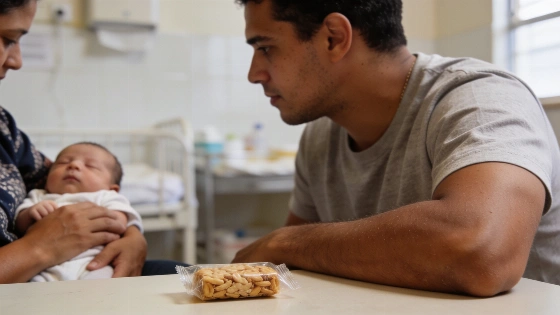
Researchers studied 43 families in Ribeirão Preto, Brazil. Newborns whose fathers reported eating more ultra-processed foods had higher birth weights and more fat in their thighs and suprailiac region, around the upper hip. The study found no increase in total body fat.
In 43 family triads, higher paternal ultra-processed food intake was associated with higher newborn weight and more fat in two measured regions, but not higher total body fat.
What the researchers found and what they did not
The team studied fathers, mothers and newborns who received care through Brazil's public healthcare system in Ribeirão Preto, in the state of São Paulo. The reported association involved birth weight and fat measured in the thigh and suprailiac regions. It did not extend to total body fat. Mariana R. Carvalho and colleagues reported the findings in Nutrition Research. Independent confirmation in other authoritative sources was not identified.
The study was part of a larger project on parental diet and newborn health. It did not involve an intervention or long-term follow-up. So it cannot establish that paternal diet caused the measured differences or show whether they affect children's health later in life. The results also do not mean that a particular packaged food, shake or ingredient predicts a newborn's size.
Claims Check: This observational study did not test nutrition shakes, protein powders, sweeteners or other individual ingredients. A product's 'clean,' 'gut health' or 'metabolism' language is not evidence that it changes pregnancy or newborn outcomes; check what the label actually discloses and whether clinical evidence supports the specific claim.
How to read a shake label without overreading the study
Ultra-processed foods are a broad category, not a single ingredient or a nutrition rating. Protein powders, ready-to-drink shakes and powdered meal replacements can differ in ingredients and intended use. The study did not compare these products or identify any one as responsible for the reported association. A long ingredient list alone does not establish a product's health effects.
When comparing shakes, start with serving size in grams and calories per serving. Then compare protein grams and added sugars on the same basis. A higher protein-to-calorie ratio describes a product's composition, but it does not establish that the product is a complete meal or clinically beneficial. For meal replacements, check whether the nutrition panel and ingredient list fit the product's stated role. Do not assume a protein powder provides the same range of nutrients.
Protein source can matter for dietary fit and formulation. Whey and casein are dairy proteins. Pea, rice, pumpkin seed and hemp are plant-based options. Check the declared protein amount and allergen information. Where relevant, consider whether the blend provides a suitable amino acid profile. Products vary. Not every plant protein blend is equivalent, and a front-label claim does not prove completeness.
Sweeteners and fibers can also affect how a product works for an individual. Stevia, monk fruit, sucralose, sugar alcohols and allulose are not interchangeable. Some people experience digestive discomfort with certain sweeteners or added fibers such as inulin. Check the ingredient list and serving amount instead of relying on broad promises such as "clean energy" or "gut health."
For products sold as dietary supplements, a Supplement Facts panel and ingredient list provide information to assess. They do not prove a marketing claim is effective. The NIH Office of Dietary Supplements offers a guide to supplement labels. Proprietary blends deserve particular scrutiny. They may disclose a combined blend weight without listing each ingredient's individual amount. That can make it harder to compare doses or judge whether a formula matches evidence for a specific ingredient.
Possible pathways remain hypotheses
The researchers propose that a diet high in ultra-processed foods could contribute to inflammation that affects sperm quality or gene activity before conception. They also discuss epigenetic changes as a possible pathway. The study did not establish that these processes caused the newborn measurements. It also did not show that a specific epigenetic change passed to a child.
The paper's discussion refers to IGF-II, a gene involved in fetal growth, and earlier research suggesting that dietary factors may relate to methylation in sperm. These ideas are hypotheses for further study. This sample did not demonstrate those mechanisms.
In the broader project, higher maternal ultra-processed food intake early in pregnancy was reported to be associated with lower birth weight, shorter length and smaller head circumference. That association also does not demonstrate causation. It is not evidence that paternal and maternal diets have opposite, predictable effects for every family.
The practical takeaway is modest. Researchers are studying nutrition before conception in both parents, but this small observational study cannot support specific family-planning advice or claims about a shake, protein powder or other product. Larger studies are needed to test whether the reported associations hold and to clarify possible mechanisms. For shoppers, the immediate task is straightforward: compare serving size, nutrients, ingredients and disclosed amounts. Treat broad health claims as claims to evaluate, not findings established by this research.