
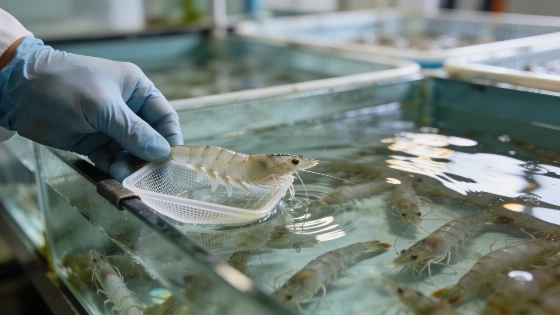
Adding a survival result to life-cycle modeling cut the estimated carbon footprint of shrimp production by up to 15% in one study. Presented at Aquaculture Europe 2026, the research found that higher dietary EPA and DHA improved several production measures, including growth and feed efficiency, as well as survival under challenge conditions. The reduction is a modeled result for that study's production system, not a universal emissions saving.
The findings also show why a feed cannot be judged by one highlighted ingredient. Researchers look at whether animals eat and use a diet, then consider how production results affect environmental calculations. For shoppers, the comparison is straightforward: look past front-of-pack claims and check serving size, ingredient amounts and what the product is meant to deliver.
In one whiteleg shrimp study, 20% inclusion of a single-cell protein coincided with lower feed intake and growth; a palatability enhancer restored intake to a level comparable with the control. Ingredient percentage alone did not predict the full formulation's performance.
Formulation weighs performance as well as ingredients
Researchers are still testing alternative proteins, but they focus on inclusion levels, digestibility and palatability rather than treating fishmeal replacement as a simple swap. dsm-firmenich tested its Protopia single-cell protein at 2.5-15% inclusion in rainbow trout. Growth held up against the control across treatments, while protein and selected amino acid digestibility improved at higher inclusion levels.
Higher inclusion did not work as well in every case. Unibio and Lucta tested Uniprotein® in whiteleg shrimp at 10% and 20% inclusion, equal to 48% and 96% fishmeal replacement. The lower level performed well, but feed intake and growth fell at 20%. A palatability enhancer brought intake back to a level comparable with the control.
In Atlantic salmon, Innovafeed and Onda studied black soldier fly larvae meal for its effects on feed intake, feed efficiency and gut health, not just as a protein substitute. Other researchers looked at mealworm meal in trout diets during thermal stress. These studies concern animal feed, not human protein powders. They do not show that an insect, single-cell or other alternative protein is suitable or beneficial in a nutrition shake. Human products have a different formulation and regulatory context, described on the ingredient list and Nutrition Facts panel.
Claims Check: An alternative ingredient is not automatically a lower-impact ingredient, just as a 'clean' or 'gut health' claim on a shake is not proof of a particular benefit. In aquaculture, the result depends on inclusion level, animal performance and the system boundary used in life-cycle analysis; consumers should likewise check whether a product's claim is supported by disclosed ingredients and relevant evidence.
Nutrition is tested under production pressures
Researchers also tested whether diets could help fish and shrimp cope with environmental stress. INRAE and Aker QRILL Company studied dietary krill meal in rainbow trout exposed to chronic hypoxia. Low oxygen raised cortisol and affected redox responses. Trout that received krill meal had a smaller cortisol response and higher total antioxidant capacity. The results suggest diet can affect physiological responses to oxygen stress. They do not show that one ingredient removes the effects of low oxygen.
Jeju National University and Orffa tested astaxanthin with an emulsifier designed to improve its use in whiteleg shrimp. The study measured growth, digestibility, immune and antioxidant responses, as well as how shrimp handled low salinity and ammonia challenges. Researchers also put plant-derived bioactives through specific tests. Anpario evaluated its oregano essential oil-based Orego-Stim in juvenile Nile tilapia before a Streptococcus agalactiae challenge. A University of Bologna, Nor-Feed and Veronesi study tested grape-derived polyphenols in trout after 60 days of feeding, then exposed the fish to a 20°C thermal challenge. These defined experiments do not, by themselves, support broad claims for people such as "immune support" or "detox."
Stress tolerance is now part of the feed-performance question, but the measures used in each study matter. The same caution applies to nutrition-shake claims such as "metabolism booster" or "clean energy": shoppers can check the specific ingredient, amount per serving and evidence relevant to that formulation instead of relying on the wording. The FDA's Nutrition Facts label guide explains the standardized information shown on packaged foods. It does not replace an assessment of a study or the product's full ingredient context.
Precision also means matching nutrients to the animal and its conditions. Adisseo tested a marine peptide concentrate in two lower-cost European seabass formulations. One cut high-quality fishmeal from 20% to 10%; the other replaced it with a lower-protein fishmeal. Either change reduced performance on its own. Peptide supplementation made up for those effects and maintained or improved growth and feed efficiency. The analysis also looked at feed costs and return on investment. That finding applies to a specific feed formulation; it does not show that peptides will produce the same result in a human protein blend.
Skretting's Atlantic salmon research combined commercial observations with controlled studies of vitamin D metabolism. Sunlight can contribute to the fish's own vitamin D synthesis, while higher dietary supplementation during winter could make up for periods with limited sunlight. Aller Aqua's stepwise feed-development work for Atlantic cod and halibut also focused on the needs of each species instead of transferring established diets from other fish. The work considered growth, deformities, gut health, alternative raw materials and water quality.
Feed performance extends beyond the fish
In recirculating aquaculture systems, feed can affect conditions after the fish eat it. A University of Lorraine, Aquaculture Experience and J. Rettenmaier & Söhne study tested lignocellulose at 1% and 2% inclusion in rainbow trout diets. Researchers measured fish performance, fecal integrity and water quality. They looked at whether firmer feces would be easier to capture, while fragmented feces could add suspended solids and organic load. Borregaard tested binders for pellet water stability. Its multifunctional binder produced the highest stability at 1% inclusion.
Environmental comparisons now look beyond ingredients to production results. Adisseo's European seabass life-cycle assessment covered the stages from cradle to farm gate. It used observed growth and feed-efficiency results to calculate impacts per kilogram of fish produced. A lower-impact ingredient does not automatically make a feed more sustainable if fish performance drops. In the same way, a nutrition shake does not become environmentally preferable just because it contains a particular ingredient. Shoppers need clear criteria and meaningful comparisons.
Aquaculture Europe 2026 ran in Ljubljana from September 28 to October 1 under the theme "Aquaculture in Global Change." Sessions covered climate adaptation, decarbonization, digitalization and innovative feed ingredients. An MRAG analysis presented at the conference estimated the marginal cost of cutting aquaculture emissions at €46-243 per tonne of CO₂-equivalent in 2026-2030, and €69-228 by 2050. The range varies by production system and measures. MRAG also estimated that feed accounts for more than half of modeled emissions across the aquaculture chain, including ingredient and feed production, transport and farm operations. These are sector-level estimates, not a score for an individual feed or consumer product.
Conference discussions also looked beyond replacing fishmeal and fish oil sourced from wild stocks. The European Commission's stated direction includes maintaining animal health and welfare while considering fisheries and processing by-products, algae, insects, single-cell proteins and fermentation technologies. A separate discussion of circularity considered shellfish shells, fish waste, farm plastics and sludge as possible raw materials. As with any ingredient system, the assessment still needs to account for traceability, processing, regulation and actual performance, not just the name on a label.
For Shake Nutrition readers, aquafeed findings do not predict how a shake will work. They do show why formulation claims need context. Check the amount and form of protein per serving, serving size, added sugars, sweeteners and allergens; compare the price per serving; and treat vague claims as a reason to look closer, not as proof. A useful sustainability or nutrition comparison explains what was measured, what it was compared with and under which conditions.