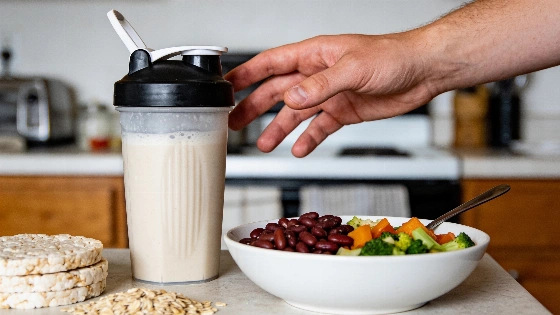
When every meal is engineered to deliver more protein, fiber-rich foods can lose their place. So can fruit and vegetables. The trade-off is easy to miss when the number on the protein label keeps climbing.
Dietitian Imogen Wolsey points to the health stakes: higher fiber intake is associated with lower risk of heart disease. It is also linked to lower risk of type 2 diabetes and bowel cancer. The UK recommends 30 grams a day. US guidance has commonly cited 38 grams for men, while the average American gets about 16 grams. On US food labels, the FDA's 28-gram Daily Value is a reference for a 2,000-calorie diet. It is not a personalized target or a guarantee that a product is high in fiber.
More protein has a point of diminishing returns
The online push for 150 or 200 grams a day often treats a bigger number as a better result. A 2018 meta-analysis published in the British Journal of Sports Medicine covered 49 studies with 1,863 participants. It found protein supplementation supported gains in lean mass and strength during resistance training. But the additional effect on lean mass did not increase beyond about 1.62 grams per kilogram of total daily protein intake.
Claims Check: A 2018 meta-analysis found that protein supplementation can support resistance-training gains, but more is not endlessly better. Across 49 studies, the additional effect on lean mass did not increase beyond about 1.62 g/kg per day of total protein intake; that is a population-level finding, not an exact personal target.
For someone who regularly strength trains and wants to build or maintain muscle, Wolsey gives a useful evidence-based range of about 1.4 to 2.0 grams per kilogram a day. An 80-kilogram person would need roughly 112 to 160 grams within that range, not an automatic 200-plus. Protein alone will not build muscle. Sufficient overall energy and progressive training matter too.
For many healthy adults, reference values offer a baseline rather than a training prescription. The European Food Safety Authority, or EFSA, sets a reference intake of 0.83 grams per kilogram per day for healthy adults. The US recommended dietary allowance is 0.8 grams per kilogram. EFSA notes that older adults may need more, but it does not set a separate official value. US guidance puts protein at 10-35% of daily energy under the acceptable macronutrient distribution range. Individual needs vary. Wolsey favors a varied, balanced diet over obsessively counting grams.
What the protein label leaves out
Protein has become a selling point on everything from cereal to coffee. Chocolate carries the claim, too. But "high protein" does not establish that a product is healthy. Start with the full Nutrition Facts or Supplement Facts panel. Check protein per serving and serving size, then look at calories and fiber. The panel also lists added sugars. Check sodium and saturated fat as well. The FDA's fiber Daily Value is 28 grams for adults on a 2,000-calorie diet. It is a practical label reference, not a measure of how much any one person needs.
With powders and shakes, compare the actual scoop weight against the protein amount instead of relying on a large "high protein" callout. A larger scoop can deliver more protein, but it can also add calories. Comparing protein per calorie helps show what a formula is designed to provide. Check the cost per serving. Read the ingredient list for protein sources and sweeteners; look separately for added fibers and allergens. If a product uses a proprietary blend, the label may give the blend's total weight without disclosing the amount of each ingredient. That makes it harder to judge whether a marketed feature has a meaningful dose.
Whole foods can deliver protein alongside other nutrients. Options include eggs and dairy, as well as fish and meat. Beans, lentils, nuts and soy provide plant-based alternatives. The American Heart Association recommends getting most protein from plant sources. It also advises regularly replacing red and processed meat with plant options, a shift associated with less saturated fat and more fiber. Shakes and bars can be convenient, but they need not replace nutritious whole foods in an otherwise balanced diet. Spreading protein across meals, rather than concentrating it in one, is another practical step.
Evidence needs the same scrutiny as labels. A finding about one form of a food or supplement does not automatically apply to another. Research on turmeric supplements, for example, does not establish the same effects from cooking with the spice.
Very high protein intake is not automatically dangerous for a healthy person, Wolsey writes, but it may displace other foods without delivering extra benefit. Anyone with kidney disease or another condition affecting protein metabolism should consult a doctor before substantially increasing protein. Wolsey is Symprove's in-house dietitian. Her written responses were provided to Men's Fitness via the gut health supplement brand.